Food Science 20 questions Quiz 1

Quiz 1 will help you revise for the Food Science part of Food Preparation and Nutrition GCSE

Use Food Science You Can Eat to help – available mid Sept 2023

1 mark for each question. ½ mark each if there are 2 answers for 1 question.

Total marks out of 20.

Answers on the link at the end of the quiz.

Caramel and Dextrin

  1. Which ingredient is used to make caramel: a) flour, b) eggs, c) sugar?
  2. What happens if you taste caramel when it has just been made?
  3. How can you test the temperature of sugar caramelisation?
  4. Why is caramel used in packets of gravy browning?
  5. Give three examples of how caramel is used in food products.
  6. Which ingredient changes to dextrin: a) sugar, b) milk, c) flour?
  7. Why does toast taste sweet?
  8. When amino acids are heated when food is roasted, what chemical reaction takes place?

Gelatinisation of starch

  1. Which of these is not a starch: a) cornflour, b) eggs, c) wheat flour?
  2. What happens when starch is heated with water?
  3. What happens to the starch in pasta when it cooks?
  4. What happens to potatoes when they cook and soften?

Enzymic browning

  1. Why is lemon juice used to coat fruit when making fruit salad?
  2. What method will not stop fruit and vegetables turning brown a) cooking for a short time, b) chilling, c) freezing?

Eggs

  1. When eggs begin to cook the protein is a) destroyed, b) denatured, c) deactivated?
  2. With more heat the egg protein a) condenses, b) sets, c) coagulates?
  3. When egg is cooked for too long, water seeps out. What is this process called?
  4. When egg is whisked and holds air, what is formed?
  5. What is the function of eggs when making mayonnaise?
  6. What happens if oil is added too quickly to mayonnaise?

Food Science Quiz 2019

Taken from Food Science You Can Eat

Using the Nutrition Program for NEA 2

My resource for Food Preparation Assessment Task NEA 2 will be available as download mid September.

This shows how the Nutrition Program cab be used for different sections of the Tasks.

If you are a Nutrition Program subscriber, email us for a free copy.

key words NEA 2

Key words used in NEA 2

The chart shows key phrases from exam boards for NEA 2 where The Nutrition Program can be used.

  • The exam boards have similar points to cover
  • Research to find dishes that fit the task –
  • Explain how the dishes meet nutritional needs
  • Look at Traffic Lights,
  • Reference Intake RI, and if they fit with a meal.
  • Look at sensory properties – use The Nutrition Program to draw up a Star Profile.
  • Carry out nutritional analysis of dishes – produce a food label using Nutrition Program
  • Portion control – see our worksheet for the Nutrition Program
  • Analyse the nutrition – annotate the food label.
  • Carry out sensory analysis and add tasters, then write evaluation – all done through Nutrition Program.
  • Use sensory descriptors – the Nutrition Program has a Tasting Word Bank
  • Cost the dish – the Nutrition Program has costs of ingredients
  • Conclude and think of improvements.

There are Step by Step links to each section of NEA2

Equipment for NEA 1 investigations

My list of essential equipment for investigations – things I have used for my experiments for NEA 1 Food Investigations 10 Tasks. This book will be available online to purchase soon. (mid Sept 2023)

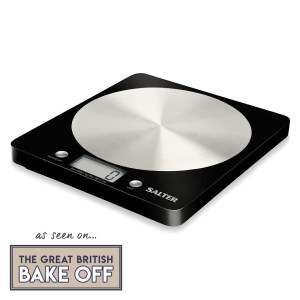
Digital scales – you need accurate measurements for testing recipes

Digital scales

Food probe  – use to test setting temperatures of egg mixtures, sauce thickening temperatures and cooking temperature.

Nutrition Program! use to find the nutritional value of flours, sugars, beans, … to help you make choices for foods to investigate.

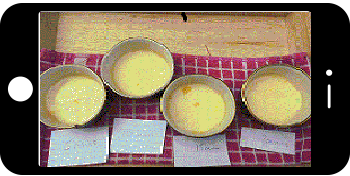
Digital camera – use your phone

Use phone to capture images
measuringcylinder

measuring cylinder

cover
NEA 1 Food Investigations 10 Tasks.

This book will be available online to purchase soon. (mid Sept 2023)

See how to create a Star Profile on the Nutrition Program

TASTING WORD BANK

See how to use a Tasting Word Bank on this link

YOUTUBE ON HOW TO DO A STAR PROFILE

See how to do a Star Profile on this link

Sugar in cakes – NEA 1

For NEA 1 you need to evaluate and annotate your results. Here’s how to do it using the Nutrition Program.

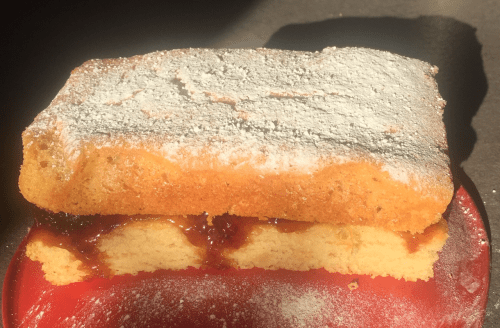
The Task – To discover what happens if you reduce the sugar in a sponge cake recipe.

We made cakes with full amount of 60g sugar and then did a batch with 50g, 40g, 30g.

You can evaluate the Functional properties of sugar in cakes – the purpose for which the ingredient is being used and can be linked to –  its structure, nutritional value, taste, texture, appearance, shelf life.

Star profile from Nutrition Program to show evaluation of results of reducing sugar in cakes.

How to do this

  1. Create a recipe for your sponge cake in My Recipes.
  2. Bake and compare your cakes and then click Star Profile
  3. Name the recipe ‘Star profile sponge cakes’.
  4. Choose descriptors – how the cake should look and taste. The descriptors we chose were – golden, yellow sponge, open texture, moist, dry.
  5. The Control cake was marked golden (5), yellow sponge (4), open texture (4), moist (4), dry (1) – this was our perfect cake.
  6. Taste the cakes and mark them on the chart – tip in the +Add Taster put the name of the cake – for example, full sugar, 50g sugar.
  7. The Nutrition Program Star Profile fills in – now you need to Evaluate the results under Evaluation – see our chart.
  8. To get extra exam marks you can annotate the Star profile.

This shows an example of annotating a Star Profile to show what the results mean.

Task

Compare the nutrition of sweeteners for cakes and desserts – use for experiments changing the types of sweetener used in cakes and desserts.

We are told to reduce the amount of ‘free sugars’ in our food, especially cakes and desserts.

But how easy is this to do and how much sugar is found in ingredients used for sweetening?

Compare the sugar content of different ingredients

To do

Use the Nutrition Program for this investigation.

Click My Recipes, +New Recipe and call it Sugar Investigation.

You want to find ingredients that you can use to sweeten cakes and the amount of sugar they contain in 100g

Find Ingredient

Type sugar and see the list. Tip – put a comma after sugar, then more appear. Some are lower sugar products.

Also choose fruits and vegetables which can be used to sweeten such as prunes and figs.

My choice

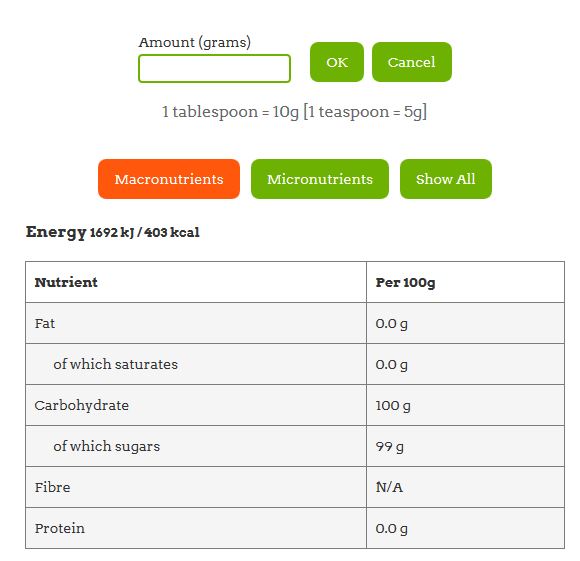
Sugar

Sugar, half spoon

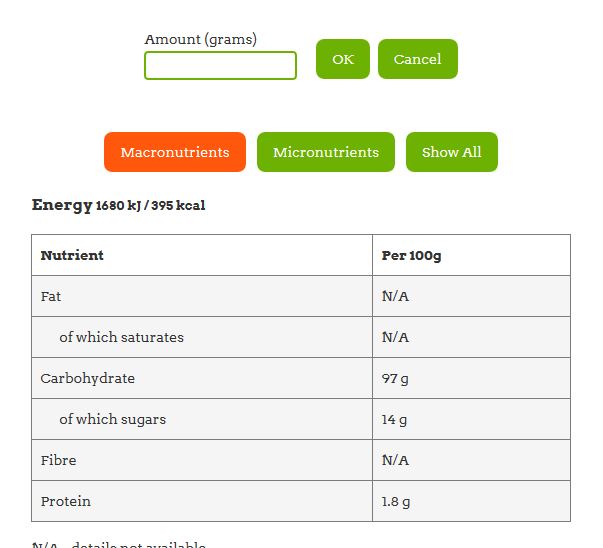
Hermesetas, granulated sweetener

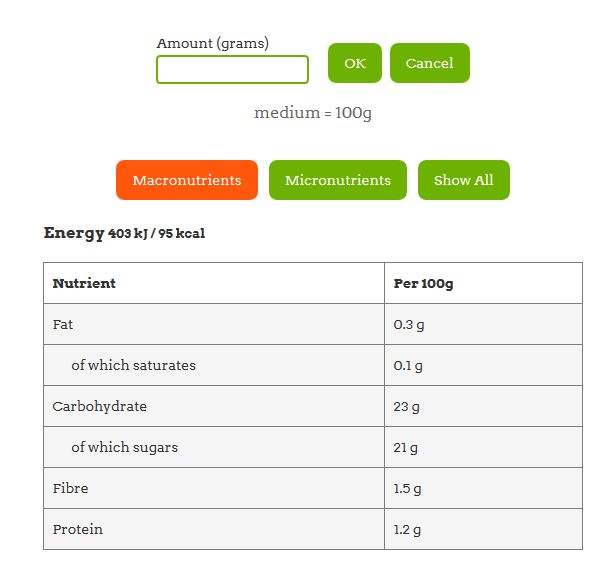
Banana

These are the results from the Nutrition Program

Nutrition of sugar
Nutrition of half spoon
Nutrition of Hermesetas
Nutrition of banana
Sweetening ingredientSugar in 100g
Sugar105 g
Sugar, half spoon99 g
Hermesetas, granulated sweetener14 g
Banana21 g

For Investigations, you need to make the cakes and find out how the results look and taste.

Then you can decide which sweeteners are the best.

Star profile of sugar in cakes with annotation

Portion sizes for NEA 2

You must show how your choice of dishes has the right portion control. But how do you know?

An average man needs 2,500kcal a day for a healthy body weight.
An average woman needs 2,000kcal a day for a healthy body weight.

Our video link shows how to use The Nutrition Program for portion sizes

How to find a portion size

Exam board NEA 2 marking statements

Planning  – Accurate portion control was evident Eduqas

Accurate and excellent knowledge of nutrition is demonstrated AQA  – need to have portion sizes to do this

Presenting – Demonstrates excellent portion control OCR 

You can check the portion size for meat, fish, chicken, fruits and vegetables on BUPA website

It’s a good idea to check out portion sizes of your favourite dishes using supermarket ready meals.

Sainsbury’s Ready Meals give clues and their site shows portions. I’ve removed the links as they keep changing.

  • Fish pie  weighs 450g serves 1 and provides 369kcal
  • Spinach and ricotta cannelloni weighs 400g serves 1 and provides 357kcal
  • Red Thai vegetable curry and rice weighs 350g serves 1 and provides 376kcal
  • Smoked haddock risotto weighs 380g, serves 1 and provides 402kcal

How many portions does crumble serve?

What about the puddings?

  • Apple and blackberry crumble portion weighs 60g, serves 1 and provides 217kcal
  • Lemon meringue pie portion weighs 100g serves 1 and provides 296kcal

So for your GCSE Food Preparation Assessment choose

Main course 350-400kcal portions – don’t forget you may serve with rice and vegetables

Desserts about 300kcal and portion 60-100g

Nadiya Hussain’s Pear and Blackberry crumble recipe which serves 4.

Each portion provides 856kcals – the average supermarket dessert provides 200-300kcal.

If portion serving were increased to 8 then the portion is reduced to 428kcal which is a healthier option.