Sugar in cakes – NEA 1

For NEA 1 you need to evaluate and annotate your results. Here’s how to do it using the Nutrition Program.

The Task – To discover what happens if you reduce the sugar in a sponge cake recipe.

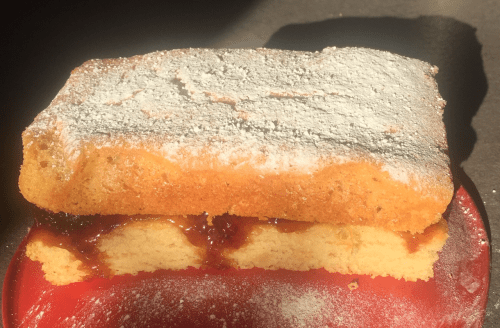
We made cakes with full amount of 60g sugar and then did a batch with 50g, 40g, 30g.

You can evaluate the Functional properties of sugar in cakes – the purpose for which the ingredient is being used and can be linked to –  its structure, nutritional value, taste, texture, appearance, shelf life.

Star profile from Nutrition Program to show evaluation of results of reducing sugar in cakes.

How to do this

  1. Create a recipe for your sponge cake in My Recipes.
  2. Bake and compare your cakes and then click Star Profile
  3. Name the recipe ‘Star profile sponge cakes’.
  4. Choose descriptors – how the cake should look and taste. The descriptors we chose were – golden, yellow sponge, open texture, moist, dry.
  5. The Control cake was marked golden (5), yellow sponge (4), open texture (4), moist (4), dry (1) – this was our perfect cake.
  6. Taste the cakes and mark them on the chart – tip in the +Add Taster put the name of the cake – for example, full sugar, 50g sugar.
  7. The Nutrition Program Star Profile fills in – now you need to Evaluate the results under Evaluation – see our chart.
  8. To get extra exam marks you can annotate the Star profile.

This shows an example of annotating a Star Profile to show what the results mean.

Task

Compare the nutrition of sweeteners for cakes and desserts – use for experiments changing the types of sweetener used in cakes and desserts.

We are told to reduce the amount of ‘free sugars’ in our food, especially cakes and desserts.

But how easy is this to do and how much sugar is found in ingredients used for sweetening?

Compare the sugar content of different ingredients

To do

Use the Nutrition Program for this investigation.

Click My Recipes, +New Recipe and call it Sugar Investigation.

You want to find ingredients that you can use to sweeten cakes and the amount of sugar they contain in 100g

Find Ingredient

Type sugar and see the list. Tip – put a comma after sugar, then more appear. Some are lower sugar products.

Also choose fruits and vegetables which can be used to sweeten such as prunes and figs.

My choice

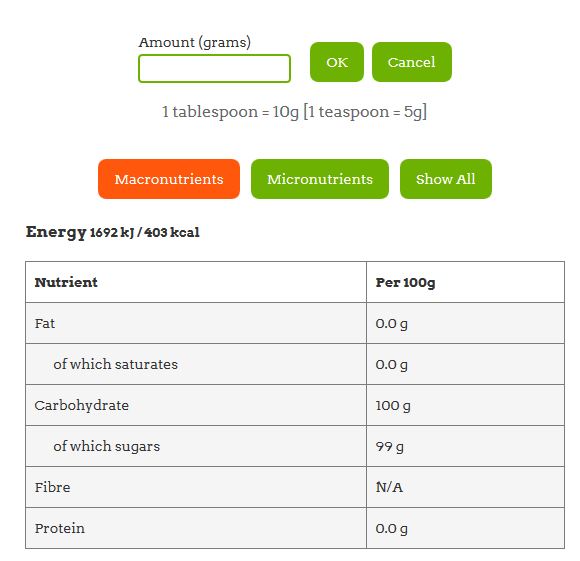
Sugar

Sugar, half spoon

Hermesetas, granulated sweetener

Banana

These are the results from the Nutrition Program

Nutrition of sugar
Nutrition of half spoon
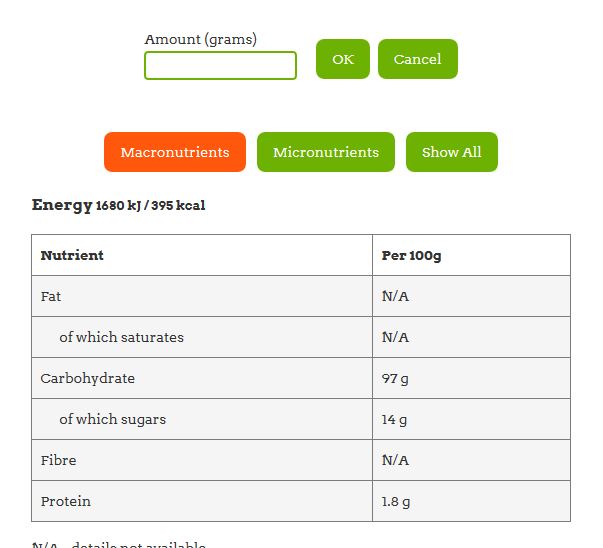
Nutrition of Hermesetas
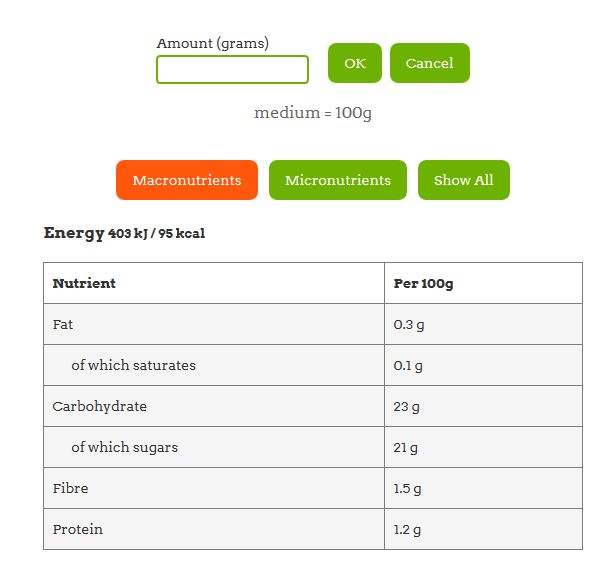
Nutrition of banana
Sweetening ingredientSugar in 100g
Sugar105 g
Sugar, half spoon99 g
Hermesetas, granulated sweetener14 g
Banana21 g

For Investigations, you need to make the cakes and find out how the results look and taste.

Then you can decide which sweeteners are the best.

Star profile of sugar in cakes with annotation

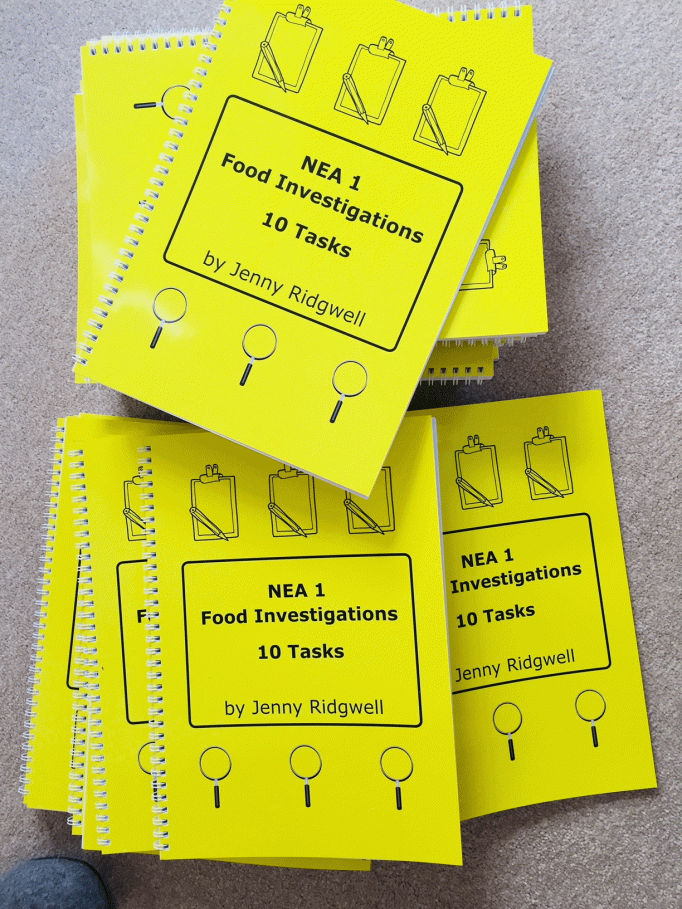
NEA 1 10 tasks

NEA 1 10 Tasks – download Sept 2024.

Ten Tasks explore how to carry out Research, Investigation, Analysis and Evaluation for each Task for all exam boards.

Tasks – thickening sauces, raising agents, fats in pastry, flours in pastry, bread, pasta, cakes, changing sugars in cakes, eggs for setting and foams

All linked to science.

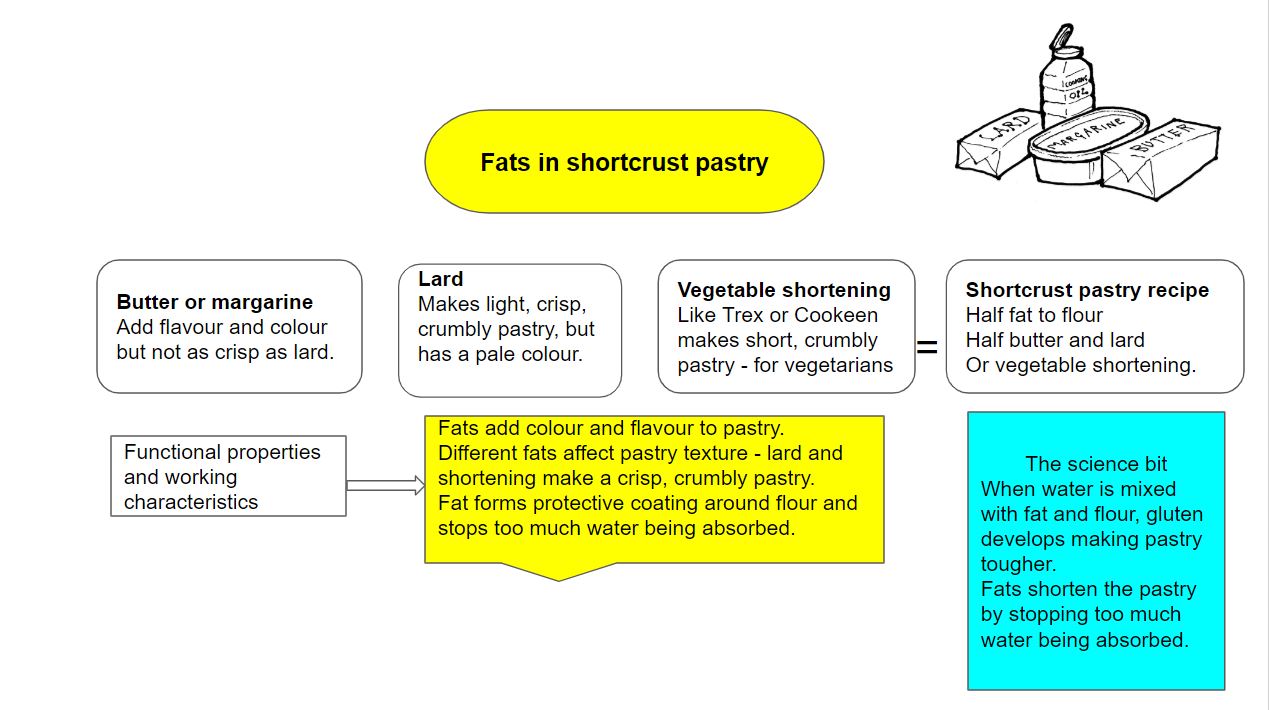
Shortcrust pastry changing the fats

fatstesting
Fats
NEA1 Ridgwell Press

Great resource! “I have used this to teach my students about Food Science. The book is very easy to follow and the experiments very accessible to students, it ideal for my GCSE classes.”

fatsstar
Make a star profile to compare results
Star profile

Egg whites and foams for meringues NEA 1

Liquid egg white used for meringue tests to discover what ingredients can be added

I’ve been doing more egg experiments this time with egg whites.

Have been using Liquid Egg white to save wasting so many eggs as there have been lots of tests to do.

The advantage of using Liquid Egg is that I can measure the egg white to use to experiment. My egg whites from eggs measured different amounts in millilitres so I had to beat some together then measure the same amount for experiments.

Use my book Food Science You Can Eat for more help

Love Food Love Science have an excellent website showing egg white foam experiments and the science behind egg white foam formation.

Protein foam formation shows how additives affect the stability of egg white foams.

The age of an egg affects its foaming ability and you can see the IFST.org tests here.

Egg white and cream of tartar whisk really well but egg yolk is flat

What whisk to use? I found that electric whisks were best to get a fair test for experiments as you can time the whisking time and level of whisking.

You can find the tests for gluten and bread, gluten and pasta and egg whites in our resource Food Investigations NEA 1 available August 2024

Use an electric whisk for a fair test
Meringue recipe testing

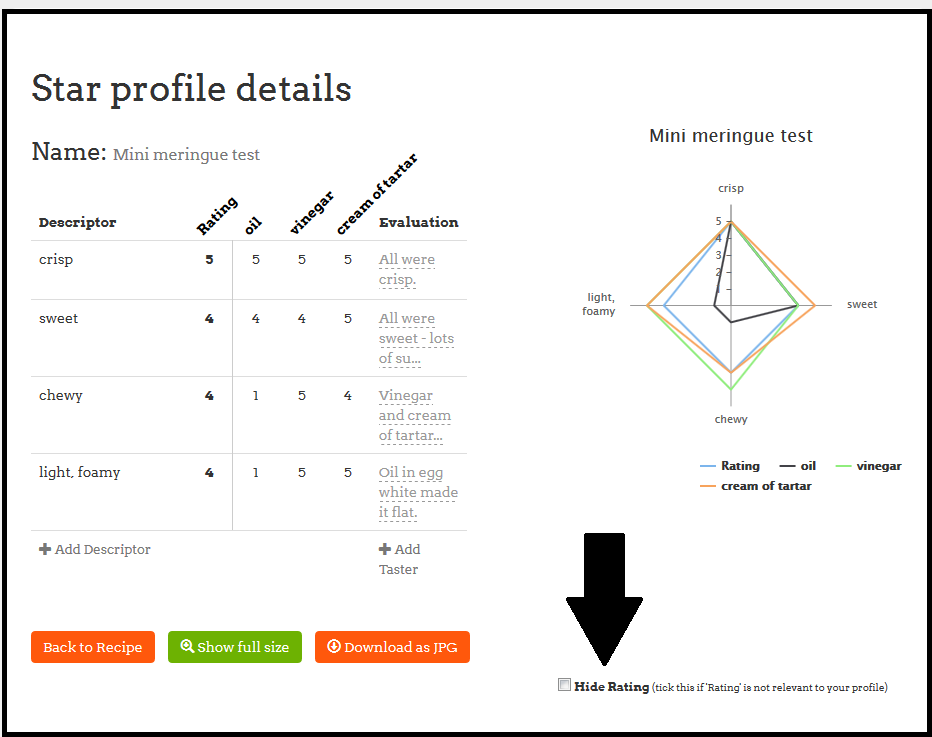
I used The Nutrition Program to present the results of the tasting. This is how it is done.

Click My Recipes and name one as Mini meringue test

Put in the basic meringue recipe in Ingredients.

I’m testing to see what happens when I add oil, vinegar and cream of tartar to egg whites.

Go to Star Profile.

For each Taster put in oil, vinegar and cream of tartar.

Then think of Descriptors for sensory appraisal – your tasting work.

I’ve chosen crisp, sweet, chewy, light foamy

Then tasted the meringues and given each a mark out of 5 where 0= not and 5= very.

This is a new function added for NEA 1 test – Click Hide Rating.

I can now see the Star Profile with each meringue tasted.

Then I can write my Evaluations.

Then Download as JPG.

Full marks I hope!!

NEA 1 Food Investigations 10 Tasks
Make a star profile to show meringue tasting results
Evaluation of meringues in star profile

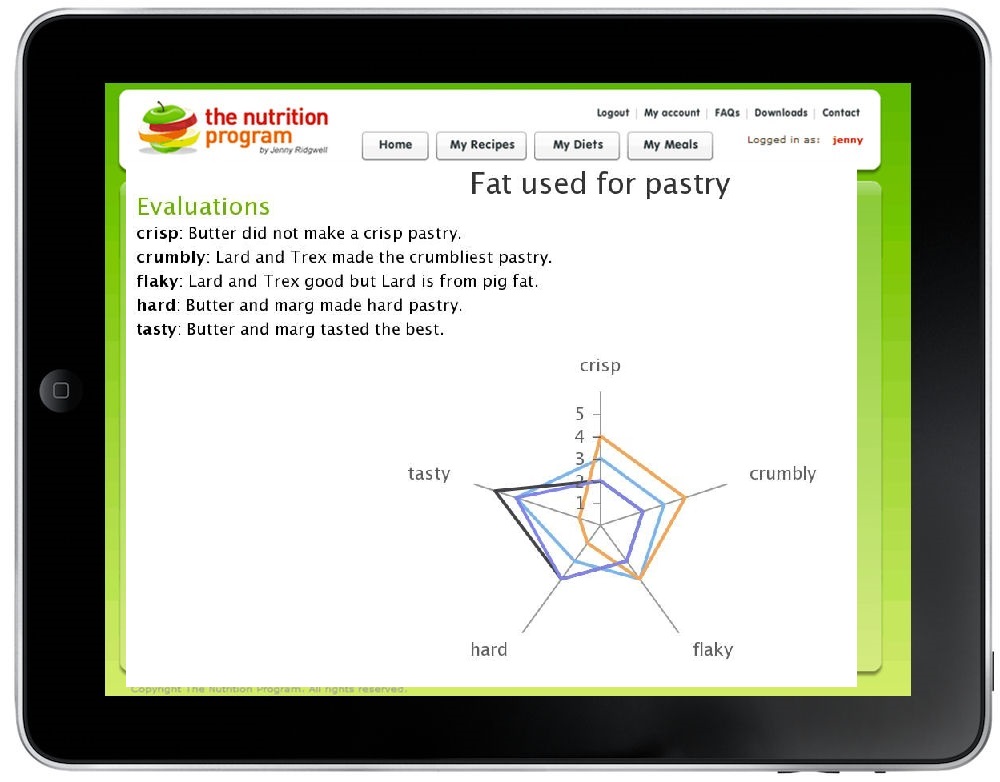
Fat used in pastry NEA 1

This star profile on Youtube shows how to create a star profile on Nutrition Program to compare fats in pastries.

This video shows how to do the star profile

I’ve used butter, lard, Trex and oil for the pastry. Taken from book NEA1 Food Investigations 10 Tasks

And Food Science You Can Eat

Click it through and see how to do an Evaluation for NEA1

1. Starting the star profile

Youtube video for star profile for pastry

How to analyse star profile for pastry

Fats in pastry 2

Results of tasting

Lard – short, crisp, tasteless, v crumbly

Butter – good flavour, quite short

Trex – light, crumbly, short, delicious

Oil – tough, dry, a little crumbly and hard.

Put the recipes into the Nutrition Program and compare results – Butter pastry, lard pastry, oil pastry, Trex pastry

This second video tells you how to finish the star profile

This Youtube video shows how to create a recipe

How to create a recipe

Use basic recipe 100g plain flour, 50g fat ( you choose) 30g water.

Plot the results on a chart

Take photos and annotate

Cooked pastries – annotated

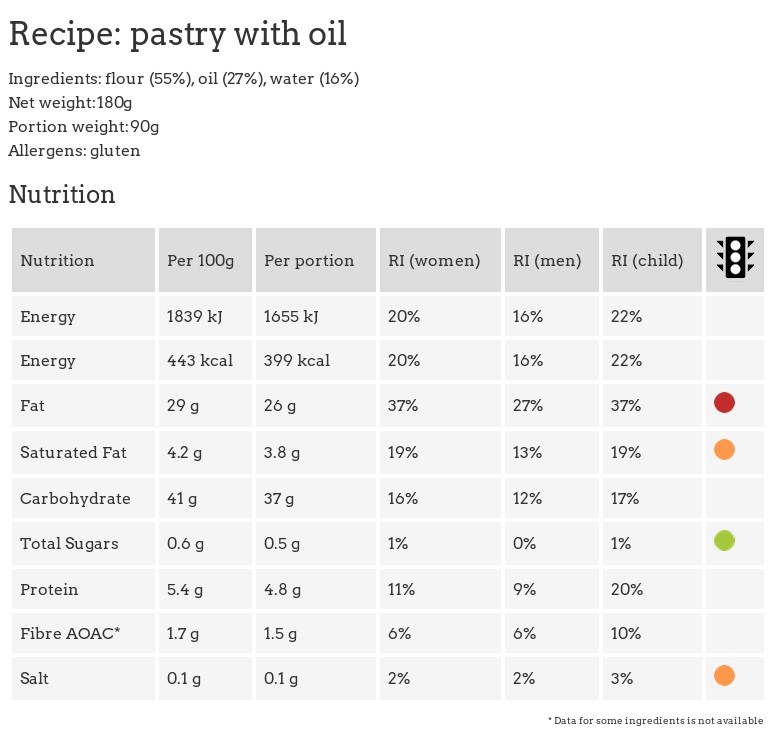
Chart shows fat and saturated fats in pastries

New books coming from Ridgwell Press for NEA 1 http://www.ridgwellpress.com

Gelatinisation of starch – NEA 1

Food and Nutrition GCSE has an Investigation NEA which could be

Investigate the ingredients used to thicken sauces and soups

Look at the Book NEA 1 Food Investigations

This is how I do it:
Think what ingredients are used to thicken sauces and soups and which starch is best for recipes.

White sauce, Tomato sauce or soup, Fruit sauce…

Starchy ingredients thicken sauces when they are heated in liquid.

So test some starches:
Rice starch, cornflour, plain flour, arrowroot, potato flour … you choose.

Create a FAIR TEST. Mix the same amount of starch (10g) with the same amount of water (100ml).

Heat each one in the microwave and look every 20 seconds, stir and remove when it is thick.

Taste and test each one.

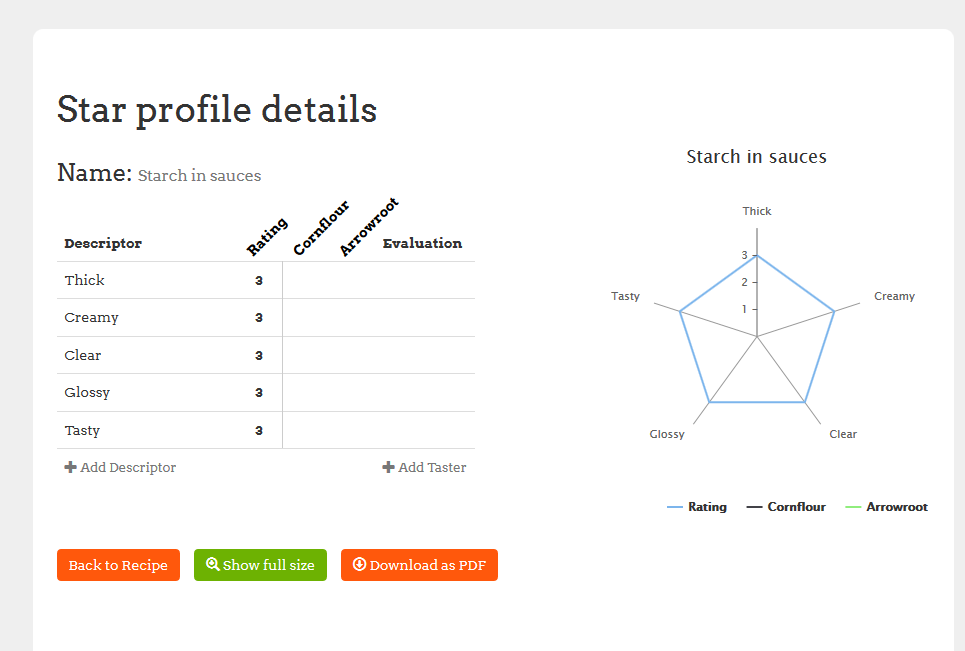
Use the Star Profile on the Nutrition Program to show your results:

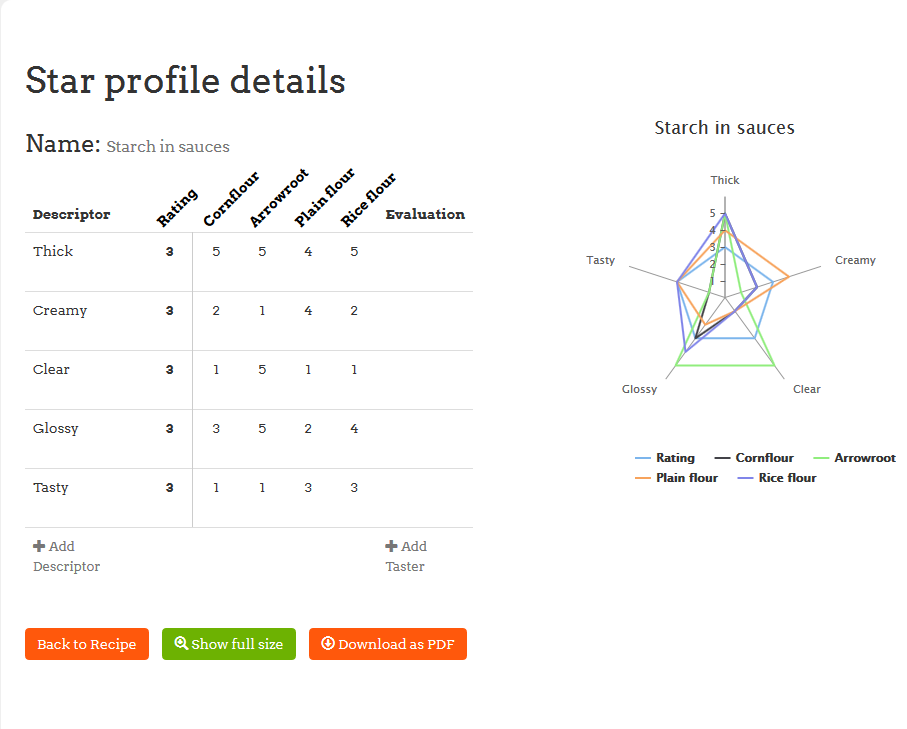
First list the starches, then choose Descriptors – words to describe the results – thick, creamy, clear, glossy, tasty …

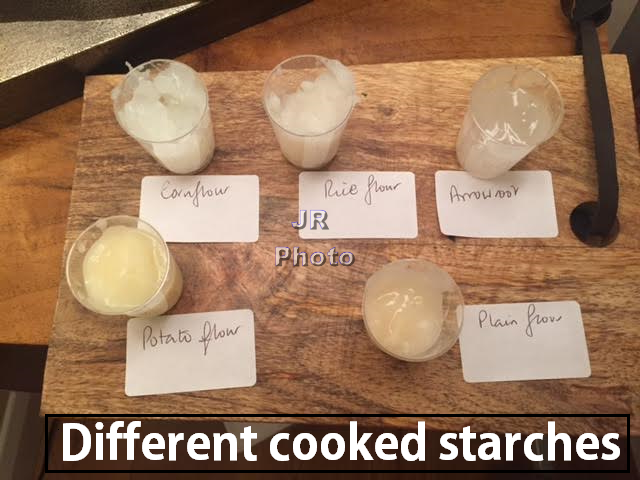
Different starches and gelatinisation
This star profile from Nutrition Program shows tasting results
This star profile shows tasting results

Fill in your tasting results:-

This star from Nutrition Program shows the results
This star shows the results for the starches
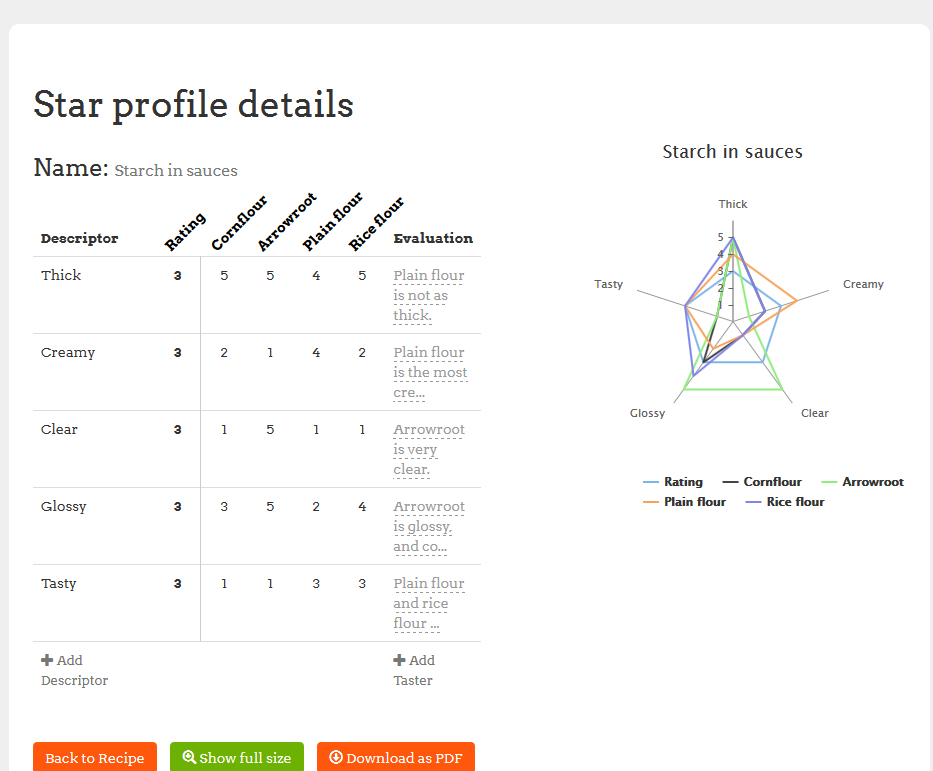
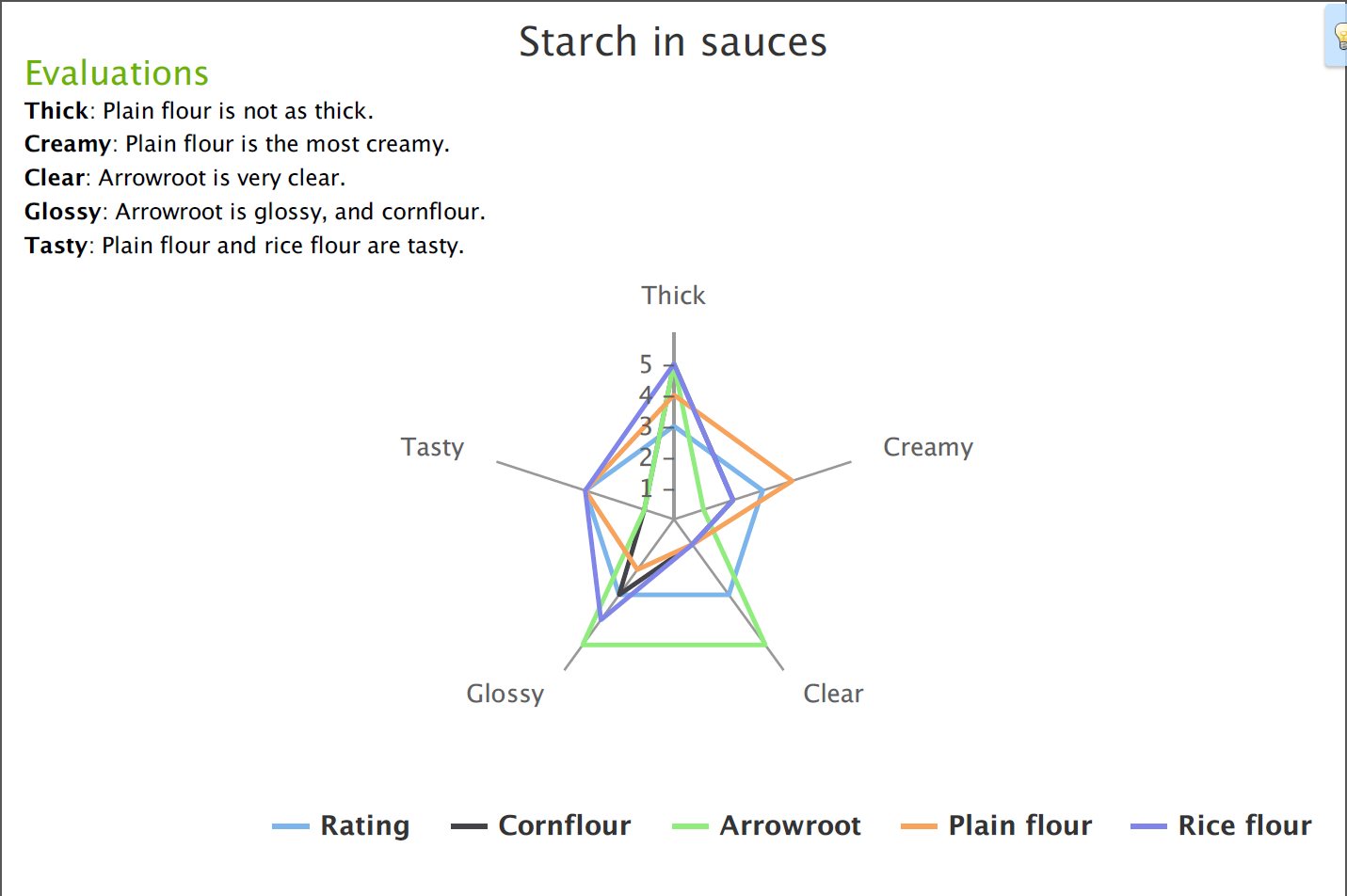
This star shows the evaluations of gelatinisation
This star from the Nutrition Program shows the evaluations of gelatinisation
These are the final results of the starch test.
These are the final results of the starch test presented using The Nutrition Program.

Save

Save

Save

Save

Star profile on YouTube for Nutrition Program