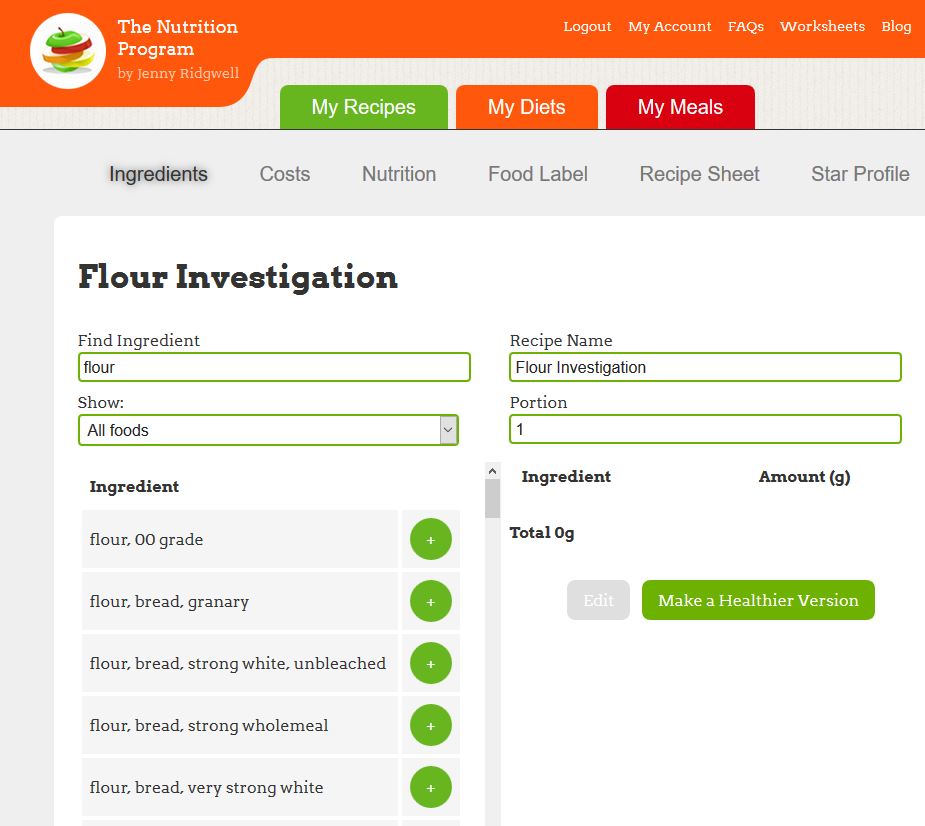
Click My Recipes, +New Recipe and call it Flour Investigation.
Find Ingredient Type flour and a whole list is shown.
Nutrition Program list of flours
If you want to look at what flours to use for bread choose 4-5 types
For example
flour 00 grade;
flour, bread, strong white;
flour, plain; flour,
self raising, white;
flour, gluten free.
Choose them each in turn – the screen shows the Macronutrients for 100 g.
Nutrition Flour 00 grade
To get nutrition for the next flour, Cancel and go back to Find Ingredient.
Collect screen images and put the results of protein in 100g on a table like the one below.
Nutrition strong white bread flour
Flour
Protein in 100g
Flour 00 grade
11g
Flour strong white bread
13g
Flour, plain
9.7g
Flour, self raising, white
8.9g
Flour, gluten free bread flour, Doves farm
4.8g
For NEA 1 research, compare the protein content – my results show that Strong, white bread flour has the most protein and so the most gluten which forms the structure of the loaf.
Here’s how you can use the Nutrition Program for GCSE Food Preparation and Nutrition NEA 1
Assessment 1: The Food Investigation Assessment 15% of total qualification
Task A Example: Shortcrust pastry should be crisp to the bite and crumbly in the mouth. It can be prepared using a range of different ingredients. Investigate the working characteristics and the functional and chemical properties where appropriate, of the different ingredients needed to achieve a perfect shortcrust pastry.
Choose fats for pastries – for example, Trex, butter, lard and margarine, lard on its own.
Think of 5 words to describe pastry – crumbly, short, buttery, light, tough.
Make and taste the pastries and put the results on My Recipes, Star Profile.
The Tasting words are listed as descriptors on the left side.
Then carry out several tastings and get marks out of 5.
The Nutrition Program creates the star as you can see below. You can then write the Evaluations of the different pastries as shown below and download your work.
Sodium bicarbonate (bicarbonate of soda, E500 sodium carbonates) is a raising agent used in soda bread and gingerbread. It is an alkali.
Cream of tartar is an acid called potassium hydrogen tartrate and it is mixed with bicarbonate of soda to provide the acid ingredient for baking powder. This ingredient can be added to stabilise whipped egg whites and increase their volume, and is added to whipped cream.
Baking powder is made from the alkali, bicarbonate of soda and the acid, cream of tartar. As soon as liquid is added to the baking powder or bicarbonate of soda, carbon dioxide gas bubbles are given off which push up the cake, muffin or bread mixture. Baking powder has a drying agent mixed with it to stop it reacting in the packet.
Make your own baking powder: Mix 1 level teaspoon bicarbonate of soda and 2 level teaspoons cream of tartar.
Self raising flour is made from plain flour and baking powder.
Make your own self raising flour: Add 1 heaped teaspoon baking powder to 100 g plain flour.
The science bit
Bicarbonate of soda produces more carbon dioxide gas if it is mixed with an acid food – cream of tartar, buttermilk, sour milk. If you don’t mix it with an acid, you get a soapy taste in the food.
Experiment to blow up balloons.
You need Bicarbonate of soda Baking powder Cream of tartar 3 small DRY 500ml plastic water bottles 3 balloons
Method
Label the bottles 1,2,3.
In 1 put 2 heaped teaspoons of bicarbonate of soda
In 2 put 2 heaped teaspoons of baking powder
In 3 put 2 level teaspoons of cream of tartar and 1 level teaspoon of bicarbonate of soda.
Boil a kettle of water. Mix 300ml boiling water with 200 ml cold water.
Pour 100ml of hot water into 1, quickly put a balloon on top and shake.
Pour 100ml of hot water into 2, quickly put a balloon on top and shake.
Pour 100ml of hot water into 3, quickly put a balloon on top and shake.
Watch what happens. Which balloon is blown up the most?
Which one does not blow up? Explain why the balloons either blow up or remain empty.
For science experiment, make soda bread or scones
What can I cook?
Irish soda bread Serves 4 Ingredients 80g self-raising flour 80g plain flour ½ level tsp salt ½ level tsp bicarbonate of soda 100ml buttermilk or 100ml milk mixed with ½ teaspoon cream of tartar or vinegar
Method
Preheat the oven to 200C/Gas 6. Lightly flour a baking sheet.
Put the flours, salt and bicarbonate of soda in a mixing bowl and stir.
Make a dent in the centre of the flour and pour in the buttermilk, or milk mixed with cream of tartar or vinegar. Mix quickly to form a soft dough.
Add less or more milk if the dough is not sticky enough.
Turn the dough onto a floured surface and knead.
Shape into a round and flatten the dough slightly before placing on the baking sheet.
Cut a cross on the top and bake for about 25 – 30 minutes or until the loaf sounds hollow when tapped. Cool on a wire rack.
What can I cook?
Cheese and onion muffins Makes 6 Ingredients 75g margarine or butter 1 small onion (50g), very finely chopped 1 egg, beaten 150 g grated Cheddar cheese 100 g self raising flour 1 level teaspoon baking powder (2g) 2 tbs milk (30g)
Nutrition per portion Energy 273 kcal, Protein 9.4g, Sugar 1 g, Fat 20g, Salt 0.9g Allergens gluten, milk, egg
Method 1. Preheat the oven to 200°C/Gas 6. 2. Melt the margarine or butter and stir in the chopped onion, beaten egg, 120g cheese – reserve the rest for the top. 3. Mix in the flour and baking powder to make a soft dough and add milk to soften the dough. 4. Place equal amounts into 6 muffin cases and bake 20-25 minutes until they are golden brown and spring back to touch. Equipment Mixing bowl, muffin tray, teaspoon, measuring jug, chopping board, sharp knife, fork, grater, muffin cases
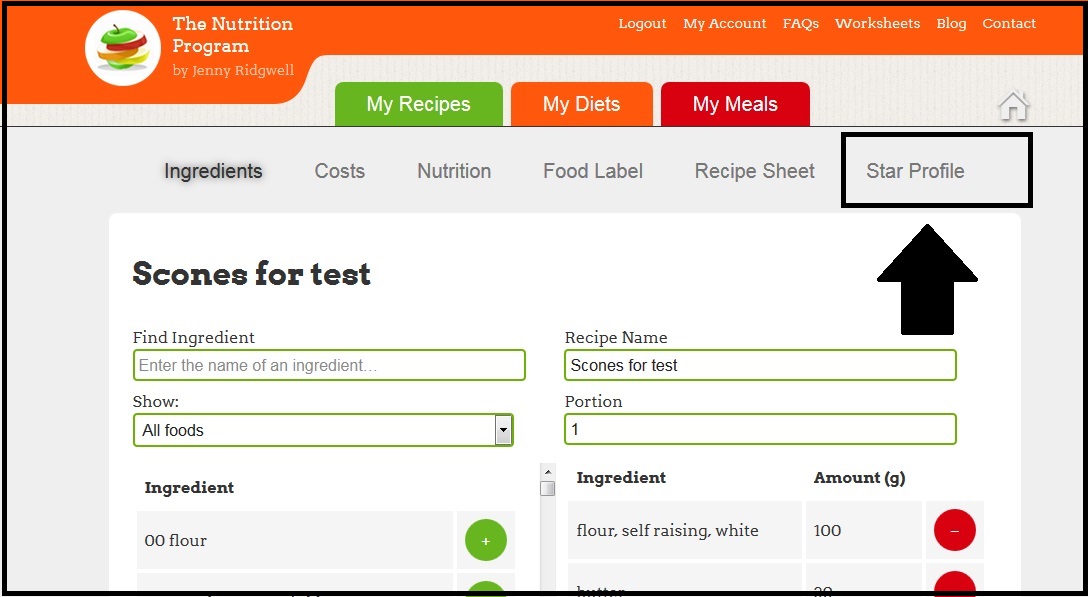
Presenting results I used The Nutrition Program to present the results of the tasting. This is how it is done. 1. Click My Recipes and name one as Scones with different raising agents 2. Put in the scone recipe in Ingredients. You can test out different scone recipes using plain flour, self raising flour, flour with bicarbonate of soda and flour with baking powder. 3. Go to Star Profile.
Star profile for chemical raising agents
For each Taster put in the name of the raising agents – I’ve chosen plain + baking powder, SR + baking powder, plain + bicarb and tartar, SR flour
Think of Descriptors for sensory descriptors. – I’ve chosen light, well risen, crumbly, solid Taste the scones and give each a mark out of 5 where 0= not and 5= very. Click Hide Rating.










 The Nutrition Program Blog