
Nutrition Program can be used to create a recipe label, star profile and costing.
- Recipe sheet
- Recipe label
- Star profile
- Nutrition analysis
- Costing


Costing for apple pie
Nutrition Program can be used to create a recipe label, star profile and costing.
Costing for apple pie
Look at our 2 YouTube videos to give step by step to help carry out a Food Investigation for Bread flour.
Bread flour Food Investigation
Bread flour results as evaluation
Task 1: Food investigation (30 marks) to find students’ understanding of the working characteristics, functional and chemical properties of ingredients.


 Flours you can use for bread – strong white bread flour, wholemeal bread flour, Unbleached bread flour, very strong white flour, seed and grain flour..
Wheat is rich in gluten, a protein that gives dough its elasticity and strength. When yeast and flour are mixed with liquid and then kneaded or beaten,gluten forms and stretches to create a network that traps the carbon dioxide bubbles produced by the yeast. This gives the bread its texture.
Strong bread flour gives the best results in bread making as it is high in gluten.
Breads made with whole wheat grains and whole wheat flour have a rich flavor as well as a coarse texture and dark brown colour.
Wholemeal flour is made from the whole wheat grain with nothing added or taken away. It will produce a bread which is more dense than a white loaf.
You can mix wholemeal flour with white flour to give a lighter loaf.
Flour with added grains or seeds can add texture to the bread and will often give the bread a lovely nutty flavour.
White flour usually contains around 75% of the wheat grain. Most of the bran and wheatgerm have been removed during the milling process. produces a lighter loaf than wholemeal flour.
Wheatgerm – This can be white or brown flour with at least 10% added wheatgerm.
Stoneground is wholemeal flour ground in a traditional way between two stones.
NEA – Compare the flours used in bread making.
What results do you want?
For the investigation I am going to use – Strong white flour, Strong wholemeal flour, white self raising flour, white plain flour.
This shows the star profile using the Nutrition Program

Star profile gluten in bread with evaluation – you need to annotate results.
NEA1 Food Investigations 10 tasks published 2018

For my Chemical raising agents investigations I tested different raising agents in warm water. See the results on this link.
When the scones were baked I took photos. They are a bit burnt! I made batches with different raising agents to compare.

Presenting results
I used The Nutrition Program to present the results of the tasting. This is how it is done.
Open the Program
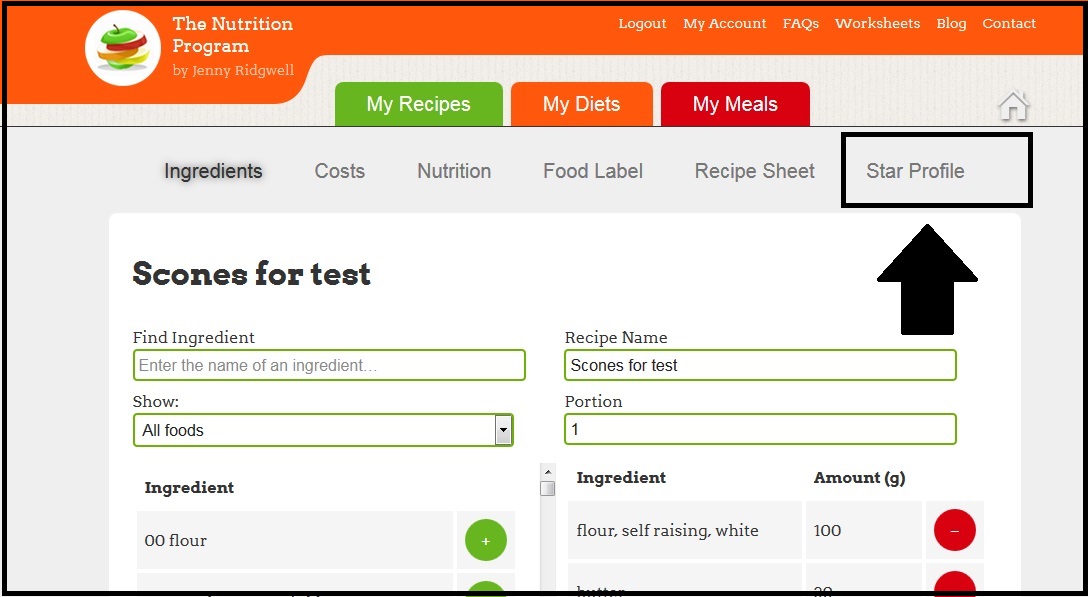
Click My Recipes and name one as Scones for test or something like that.
Put in each scone recipe in Ingredients.
Go to Star Profile.
Star profile for chemical raising agents
For each Taster put in the name of the raising agents – I’ve chosen plain + baking powder, SR + baking powder, plain + bicarb and tartar, SR flour
Then think of Descriptors for sensory appraisal – your tasting work.
I’ve chosen light, well risen, crumbly, solid
Then I tasted the scones and gave each a mark out of 5 where 0 = not and 5= very.
This is function is added to The Nutrition Program for NEA 1 test – Click Hide Rating.

Star profile for chemical raising agents
I can now see the Star Profile with each scone tasted.
Then I can write my Evaluations.

Evaluation of raising agents
Then Download as JPG and write some comments

Full marks I hope!!
All this work and more appear in Food Science You Can Eat

 The Nutrition Program Blog