Fats and Nutrition

UK government guidelines advise cutting down on all fats and replacing saturated fat with some unsaturated fat.

Try this worksheet using the Nutrition Program for foods high in fat, sugar and salt.

A small amount of fat is an essential part of a healthy, balanced diet.
Fat is a source of essential fatty acids such as omega-3 – essential because the body can’t make them itself.

Fat helps the body absorb vitamins A, D and E. These vitamins are fat-soluble, meaning they can only be absorbed with the help of fats.

All types of fat are high in energy. A gram of fat, whether saturated or unsaturated, provides 9kcal of energy.

Most fats and oils contain both saturated and unsaturated fats in different proportions.

Saturated fats are found in many foods, both sweet and savoury.

Foods high in saturated fats include:

  • fatty cuts of meat
  • meat products, including sausages and pies
  • butter, ghee and lard
  • cheese, especially hard cheese
  • cream, soured cream and ice cream
  • some savoury snacks and chocolate confectionery
  • biscuits, cakes and pastries
  • palm oil
  • coconut oil and cream

Saturated fat guidelines

  • The average man should aim to have no more than 30g of saturated fat a day.
  • The average woman should aim to have no more than 20g of saturated fat a day.
  • Children should have less.

Food labelling

  • high fat – more than 17.5g of fat per 100g
  • low fat – 3g of fat or less per 100g, or 1.5g of fat per 100ml for liquids (1.8g of fat per 100ml for semi-skimmed milk)
  • fat-free – 0.5g of fat or less per 100g or 100ml

Saturated fat

  • high in sat fat – more than 5g of saturates per 100g
  • low in sat fat – 1.5g of saturates or less per 100g or 0.75g per 100ml for liquids
  • sat fat-free – 0.1g of saturates per 100g or 100ml

NRVs and food labelling

I’ve just discovered that fat labels show NRVs so it’s time to get up to date.

NRV stands for Nutrient ReNRV's Nutrient Reference Valueference Value.

It is a replacement term for RDA (Recommended Daily Allowance) and you will see it on some products from December 2014 – a new European regulation.

NRV is a guideline of the minimum amount of a particular vitamin or mineral required by the average person to stay healthy

So instead of % RDA you will see %NRV’s.

Vitamin B3 is listed as Nicotinic acid.

Allergens are listed in bold.

Sodium will  be labelled salt.

Nutrition Expert is a useful website.


RDA’s (Recommended Daily Allowance) have now changed to NRV’s (Nutrient Reference Values). Instead of 100% RDA, you will now see 100% NRV. The values for RDA and NRV’s are exactly the same – NRV is a straight replace of RDA.

NRVs (Nutrient Reference Values) are a set of recommendations for nutritional intake based on currently available scientific knowledge. They state the level of intake of essential nutrients considered to be adequate to meet the known nutritional needs of practically all healthy people for the prevention of deficiencies, i.e the amount of vitamins and minerals you need to be consuming to prevent becoming ill.

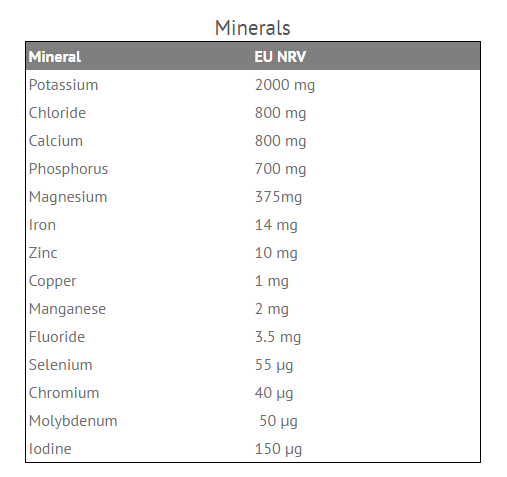
Current (May 2016) Nutrient Reference Value (NRV) for vitamins and minerals as set in the EU can be seen below:

NRV minerals

Save

Save

What’s happened to margarine?

Where has margarine gone? In the 1970’s when I taught cooking in east London we only used margarine and the Stork home economists came into school and showed us the all in one cake and sauce. Now Stork is called Stork original spread and is labelled 70% Vegetable Fat Spread.


Have I missed something!!! Stork is just labelled Perfect for Pastry or Perfect for cakes.


So you can’t buy margarine in a shop any more so what fat am I supposed to suggest as a butter alternative without advertising the brand???

There is a European Margarine Association  telling me that margarine has been around for nearly 150 years and that I must visit www.spreadthewordaboutmargarines.org

They say ‘Margarine comes in 3 forms: soft and spreadable margarines (in tub), liquid cooking blends (in bottle) and hard blocks that are great for baking (in wrapper)’

But type ‘margarine’ into a supermarket website and no products are listed as margarine.

Margarine and Spreads Association  but that leads me to The Art of Home Cooking which is an ancient Stork book – so has Margarine disappeared?

I will Tweet

Popcorn – nutrition and gelatinisation NEA 1

Popcorn makes a fun lesson for food science and you can explore lots of food knowledge.

I know it’s not a healthy food, but that’s the point – let students discover its nutrition – mostly starch.

Here’s some activities you can investigate

  • For teachers – what is the value of a lesson with popcorn?
  • Find 20 popular products made from maize. Now plan a day’s meals and snacks with foods made from maize.
  • Find the nutritional value of plain popcorn and then find health claims people are making
  • What is the science behind popped corn? Look at popping kernels then look at popped corn and work it out!
  • How much does it cost? Compare supermarket sites for cost 100g. Where does it come from?
  • Get hold of a bag of cinema popcorn and fill it with popcorn you have made – work out how much it has cost.

Nutrition of cinema popcorn

I can’t find the weight of Cinema popcorn but here’s some nutrition data from The Odeon – fascinating reading.

Sweet popcorn – small 318 kcal 15g sugar 3.5 tsp sugar

Sweet popcorn – medium 522 kcal 26g sugar 6 tsp

Sweet popcorn  – large 816 kcal 40g sugar 9 teaspoons sugar

Salt popcorn – small 357 kcal 0.48g sugar 0.7g salt

Salt popcorn – medium 609 kcal 1.2g salt

Salt popcorn – large 812 kcal 1.6 g salt

Small coke 195 kcal, 48g sugar (11 tsp)

Small fanta 195 kcal, 48g sugar (11 tsp)

Large coke 390 kcal, 97g sugar (22 tsp)

World Health Organisation suggests we cut sugar to 5% daily intake.

That’s about 25g (around six teaspoons) for an adult of normal weight every day.

A teaspoon of sugar weighs 4.4g so

The large popcorn bags are intended for sharing but are often eaten by just one person.

Make your own popcorn in a microwave

Ingredients

10g popping corn

Equipment – clear plastic food container with lid, plate

Method

Put the popping corn in the food container and put lid on top.

Cook in the microwave for 1 minute. Some kernels may begin to pop. Removed the popped ones and microwave for a further minute.

Remove the popped kernels and heat the remaining ones again. You will find that some do not pop – this is because they are too hard and dry.

Take care when you open the lid as the steam is hot.

Now think of the science – the kernel is heated and the water in the kernel heats and turns to steam.

The starch in the kernel gelatinises with the water and expands and the steam and the cooked starch explode outside the kernel.

This bursts the grain and the starchy gooe turns inside out and the protein in the maize coagulates forming the popcorn.

  1. Heat the oil in a large, thick bottom saucepan.
  2. Put 4-5 popping corns into the oil and when they pop, add the remaining corns.
  3. Cover with a tight fitting lid and remove from the heat. Count to 30 – this brings all the corns to the right temperature ready for popping.
  4. Put the pan back on the heat with the lid on – you can hear the corns popping.
  5. Leave the lid slightly open to allow steam to escape.
  6. When the popping begins to stop, remove from the heat and put the popped corn into a bowl.
  7. Remove any unpopped corn – these are very hard and can break your teeth.
  8. Popcorn needs to be eaten soon after it is made – or store in a closed plastic bag for a short time.

Flavour the corn with salt mixed with finely ground spices such as smoked paprika, cumin and coriander.

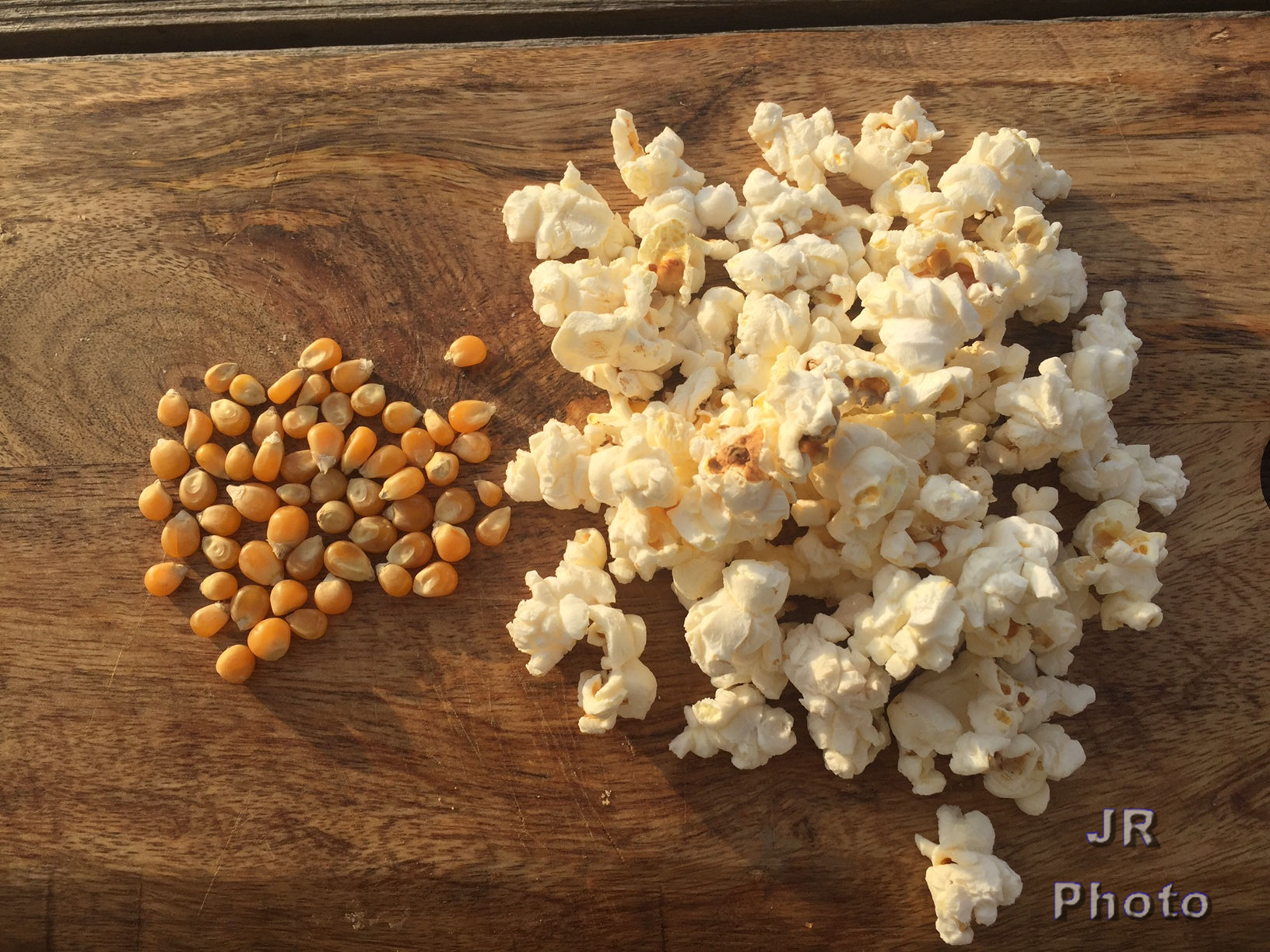
popcorn kernels and cooked

Unpopped corn and the cooked amount

Sweet popcorn can be tossed with icing sugar and cinnamon.

Save

Save

Save

Save

Save

Save

Save

Save

Save

Save

Nutrition analysis, star profile and costing

 Nutrition Program can be used to create a recipe label, star profile and costing.

  • Recipe sheet
  • Recipe label
  • Star profile
  • Nutrition analysis
  • Costing

Apple pie food-labelStar profileApple pie nutrition


Nutrition for apple pie

Costing for apple pie