

Subscribe to continue reading
Subscribe to get access to the rest of this post and other subscriber-only content.
Subscribe to get access to the rest of this post and other subscriber-only content.
Here’s how you can use the Nutrition Program for GCSE Food Preparation and Nutrition NEA 1
Assessment 1: The Food Investigation Assessment 15% of total qualification
Task A Example: Shortcrust pastry should be crisp to the bite and crumbly in the mouth. It can be prepared using a range of different ingredients.
Investigate the working characteristics and the functional and chemical properties where appropriate, of the different ingredients needed to achieve a perfect shortcrust pastry.
Choose fats for pastries – for example, Trex, butter, lard and margarine, lard on its own.
Think of 5 words to describe pastry – crumbly, short, buttery, light, tough.
See our Tasting Word Bank.
Make and taste the pastries and put the results on My Recipes, Star Profile.
The Tasting words are listed as descriptors on the left side.
Then carry out several tastings and get marks out of 5.
The Nutrition Program creates the star as you can see below. You can then write the Evaluations of the different pastries as shown below and download your work.

YouTube video using a star profile to evaluate
This is the star profile for sugar in sponge cakes.

Jamie Oliver’s Sugar Rush is campaigning to raise awareness of sugar in fizzy pop.
The Great British Bakeoff asked contestants to make sugar free cakes but they added agave syrup and honey instead – which are counted as free sugars.
Better way to use fruit and vegetables such as carrots and apples. Dr Sally Norton said:
‘That way we will appreciate the more subtle sweetness of fruit, veg, and reduce our risk of health problems and dental decay.’
The Scientific Advisory Committee on Nutrition (SACN)
Added sugar should not make up more than 5% of total energy.This around 30g of sugar a day.
In UK children aged 11-18 years are getting 15% of daily calories from added sugar.
Food label
>22.5g/100g total sugars is high
<5g/100g total sugars is low.
The drinks with up TWENTY teaspoons of sugar – Daily Mail article
The Scientific Advisory Committee on Nutrition (SACN) recommends that:
Free sugars should account for no more than 5% daily dietary energy intake.
The term free sugars is adopted, replacing the terms Non Milk Extrinsic Sugars (NMES) and added sugars ( sucrose (table sugar),fructose, glucose). Free sugars are those added to food or those naturally present in honey, syrups and unsweetened fruit juices, but exclude lactose in milk and milk products. It does not include the sugars naturally present in intact fruit and vegetables and dairy products.
At the moment food labels here in the UK only account for total sugar, not free sugars. This can make it difficult to distinguish the difference between sugars naturally present in a food and those with sugar added. Hopefully in future this will change and this report will result in changes made to food labelling laws to incorporate added sugars to help consumers make informed choices. Until this happens, look at the ingredients list to see whether there are sugars added to a particular food product. The higher up the list, the bigger the proportion as ingredients are listed in order of quantity.
New evidence has led SACN to propose broadening the definition of dietary fibre currently used in the UK. SACN is proposing that adults should consume 30g fibre/day measured according to the new definition.
Science term – gelatinisation
You need to use risotto rice as it contains a high amount of starch and gives a soft, creamy texture but the grains remain chewy when cooked.
As you cook this risotto you can see the starch in the rice grains changing as the grains swell, absorb the liquid, swell and release the starch into the cooking liquid.
What can I cook?
Pea and carrot risotto
Serves 4
Ingredients
100g onion, finely chopped
30g oil
150g risotto rice
7g vegetable stock cube
600g boiling water
100g frozen peas
1 carrot (60g), grated
30g finely grated Parmesan cheese
5g of parsley finely chopped
Method
Heat the oil in a heavy based pan and add the chopped onion. Stir and cook for 5 minutes until onion is soft.
Stir in the rice and coat the grains in oil.
Dissolve the stock cube in boiling water and gradually stir into the rice.
Cook for 15 minutes as the rice absorbs the liquid. Add the peas and grated carrot and stir.
Taste to see if rice grains are soft and serve with chopped parsley and Parmesan cheese.
Equipment
chopping board, sharp knife, large pan, wooden spoon, grater, measuring jug
Nutrition
Energy per portion (270g) 2371 kcal, Protein 7.5g, Sugar 1.2 g, Fat 3.9g, Salt 0.9g
Allergens none
The science bit
As the rice is cooking, the stirring helps the starch grains release starch into the cooking liquid. The grains soften as the starch gelatinises, and the starch in the liquid thickens the sauce giving the risotto its creamy texture.
My talk in March 1st 2014 ‘Maths and food teaching’ Teachers are asked to help develop maths skills in every subject and food teaching needs a wide range of maths skills. Using the Nutrition Program we will explore the new food labelling regulations and look at all the maths involved in understanding the nutritional value of recipes, meals and diets.’
Free Maths and Food Technology is on this link.
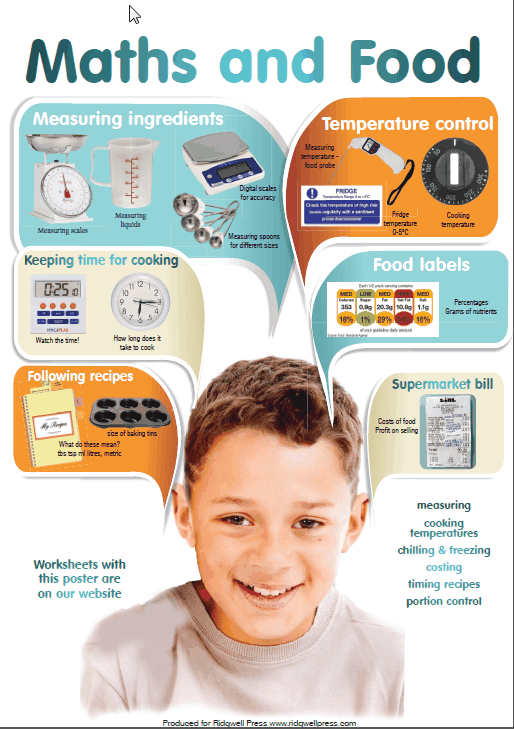
This talk on Maths – Powerpoint on this link.
3663 is one of the largest suppliers of wholesale food and catering but do you know why they use these numbers?
Email me the answer – it’s embeded in the talk. 
This is how teacher Linda Martin includes Numeracy in her lessons.
‘The majority of my lessons have references to Maths.
I want students to understand the importance of how other subjects can help them in Food Technology
I will use a basic recipe and I will double it, treble it and so on
Swiss Roll
3 eggs , 75g Flour, 75g Caster Sugar
I will ask the class what would the quantities be for 2 egg or 4 eggs
Similarly Shortcrust pastry 25g flour, 12g fat, 5ml water – Scale this up.
With the Nutrition Program look at % of GDA
I will reference Bar Charts, Pie Charts – I know you have been working in Maths on Pie Charts.
All the scales we use are balance scales and this is particularly helpful for the less able and it is very visual, meets the needs of different learning styles.
We work in Metric but I also have conversion charts.
For the Program I pair students up, although they are working individually I try to have one that is more confident with numeracy and ICT skills and they can usually be a coach for the weaker student. I find they very quickly get the hang of it.
Linda Martin The Community College, Shropshire
 The Nutrition Program Blog