Cut down on sugar – especially free sugars

Jamie Oliver’s Sugar Rush is campaigning to raise awareness of sugar in fizzy pop.

The Great British Bakeoff     asked contestants to make sugar free cakes but they added agave syrup and honey instead – which are counted as free sugars.

Better way to use fruit and vegetables such as carrots and apples. Dr Sally Norton said:

‘That way we will appreciate the more subtle sweetness of fruit, veg, and reduce our risk of health problems and dental decay.’

The Scientific Advisory Committee on Nutrition (SACN)

  • High levels of sugar consumption are linked with a greater risk of tooth decay.
  • The higher the proportion of sugar in the diet, the greater the risk of high energy intake.
  • Drinking high-sugar beverages results in weight gain and increases in BMI in teenagers and children.
  • Consuming too many high-sugar beverages increases the risk of developing type 2 diabetes.

Added sugar should not make up more than 5% of total energy.This around 30g of sugar a day.

In UK children aged 11-18 years are getting 15% of daily calories from added sugar.

Food label
>22.5g/100g total sugars is high

<5g/100g total sugars is low.

The drinks with up TWENTY teaspoons of sugar – Daily Mail article


The Scientific Advisory Committee on Nutrition (SACN) recommends that:

Free sugars should account for no more than 5% daily dietary energy intake.

The term free sugars is adopted, replacing the terms Non Milk Extrinsic Sugars (NMES) and added sugars ( sucrose (table sugar),fructose, glucose). Free sugars are those added to food or those naturally present in honey, syrups and unsweetened fruit juices, but exclude lactose in milk and milk products. It does not include the sugars naturally present in intact fruit and vegetables and dairy products.

  • 19g or 5 sugar cubes for children aged 4 to 6,
  • 24g or 6 sugar cubes for children aged 7 to 10,
  • 30g or 7 sugar cubes for 11 years and over
“Cut down on sugars, increase fibre and we’ll all have a better chance of living longer, healthier lives.”

FREE SUGARS INCLUDE:

  • Table sugar (sugar cane/ beet/other sources)
  • Golden Syrup
  • Molasses or Treacle
  • Agave syrup
  • Rice malt syrup
  • Coconut blossom syrup
  • Maple syrup
  • Coconut sugar
  • Honey
  • Unsweetened fruit juice
  • **Any other sort of syrup that I have failed to mention typically used as a sugar replacer that contains sugar in the food label!

WHAT DOESN’T COUNT AS FREE SUGARS?

  • Lactose in milk and dairy products
  • Sugar naturally present in fruit, including dried, canned and stewed
  • Sugar naturally present in vegetables
  • Sugar naturally present in grains and cereals

FOOD LABELLING OF FREE SUGARS

At the moment food labels here in the UK only account for total sugar, not free sugars. This can make it difficult to distinguish the difference between sugars naturally present in a food and those with sugar added. Hopefully in future this will change and this report will result in changes made to food labelling laws to incorporate added sugars to help consumers make informed choices. Until this happens, look at the ingredients list to see whether there are sugars added to a particular food product. The higher up the list, the bigger the proportion as ingredients are listed in order of quantity.

Good website to use

The current recommendation that starchy carbohydrates, wholegrain where possible, should form 50% of daily calorie intake is maintained
Fibre
Those aged 16 and over increase their intake of fibre to 30g a day, 25g for 11-to 15 year olds, 20g for 5 to 11 year olds and 15g for 2 to 5 year olds.
Free sugar should be reduced to 5% of daily calorie intake to improve and protect health.

New evidence has led SACN to propose broadening the definition of dietary fibre currently used in the UK. SACN is proposing that adults should consume 30g fibre/day measured according to the new definition.

The proposed new definition of fibre encompasses all carbohydrates that are naturally integrated components of foods and that are neither digested nor absorbed in the small intestine and have a degree of polymerisation of three or more monomeric units, plus lignin
30g of fibre a day by eating five portions of fruit and vegetables, two slices of wholemeal bread, a portion of high fibre breakfast cereal, a baked potato and a portion of whole wheat pasta.
 Agave comes from the cactus and is 1.5 times sweeter than sugar. It has a low glycaemic index so doesn’t cause energy spikes. It’s 90% fructose which is metabolised by the liver and converted to fat. It can lead to insulin resistance.


Portion sizes

Our portion sizes for the Nutrition Program come from supermarket websites – Sainsburys Waitrose Aldi Co-op Morrisons  Tesco.

Look up the food dish you are making on the supermarket website and see how much a portion weighs. Tesco has a Healthy Living range with reduced salt, sugar, fat and calories
The Co-op has ready meals with less than 500 calories
School Food Plan has excellent charts on portion sizes

School Food Plan portion

BUPA has an excellent website with portion sizes for different foods.

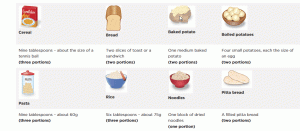
Starchy foods

Strachy food portions

Meat, fish and other proteins

Portion sizes

Dairy foods

portion sizes

McCance and Widdowson’s The Composition of Foods 7th Edition

McCance and Widdowson’s (7th edition) – we will implement the 7th Edition into our database when available as a downloadable database.

The Composition of Foods, Seventh Summary Edition MW7 is prepared by IFR Institute of Food Research and the FoodComp team for publication by RSC Royal Society of Chemistry – September 2014

Updates and changes in McCance and Widdowson’s The Composition of Foods, Seventh Summary Edition MW7

  •       All data have been extensively reviewed – scientists have compared and added new industry data, new analytical data and recalculated all recipes. They have also reviewed and revised the list of foods contained in MW7 to reflect commonly consumed foods in the UK
  •       New data from analytical surveys includes foods in the following groups: flours and grains, bread, pasta, breakfast cereals, biscuits, cakes, eggs, fat spreads, fruits, vegetables and fish and fish products.
  •       The tables now include AOAC – scientists have analysed values for all new analytical data.  The edible conversion factor has been removed and replaced into a table in the back of the book.  In its place is a column to describe the main data reference (including year of analysis).
  •        The online Integrated Dataset (containing all foods) will be updated to coincide with the MW7 release.

There are also entries for many foods that have become popular in recent years such as fresh pasta and creme fraiche.

creme fraiche

The Seventh Edition is currently being prepared by IFR Institute of Food Research and the FoodComp team for publication by RSC Royal Society of Chemistry

UK FoodComp is a 4 year project to update CoFIDS – the Composition of Foods.


Online UK Composition of Foods Integrated Dataset (CoFIDS)

The Food Standards Agency (FSA) maintains the UK Nutrient Databank, with information on the nutrient content of foods commonly consumed in the UK.

The McCance and Widdowson’s The Composition of Foods (CoF) book series, i.e. the 6th Summary Edition and supplement publications, contains nutrient composition data based on information from this databank.

The CoF IDS lists analytical nutrient data for 3,423 foods. The data are divided across 16 worksheets and include nutrient data for macronutrients, vitamins, vitamin fractions, minerals, fatty acid fractions, phytosterols, and organic acids, as well as providing recalculated values for a selection of foods in the format required for nutrition labelling.


Any enquiries regarding the use and re-use of this information resource should be emailed to:psi@nationalarchives.gsi.gov.uk

Recent FSA analytical surveys

Thirty-two composite samples were analysed for energy and a range of nutrients including fat, protein, carbohydrate, fibre and a full range of vitamins and minerals. Foods analysed were farmed and wild salmon, quiche, cook-in sauces, stir fry sauces, American muffins, Jaffa Cakes, coffee, sushi, vegetarian mince, rice cakes, premium chilled carton soups, potato wedges, vegetable curry (ready meal) and cake bars. Nutrient levels were in line with those found previously in other, similar foods.32foodsfromfoodstandards

Technical guidance on the nutrition provisions of Regulation (EU) No. 1169/2011 on the provision of food information to consumers (EUFIC), and to our guide to the (voluntary) UK front of pack labelling scheme announced in June

Frontofpack

Frontofpack2

The EU FIC text can be found at:

NHS Choices webpage on food labels

http://www.fdf.org.uk/understanding-food-information-regulation-event-sep13.aspx

Bills Cafe in Lewes

Bills cafe in Lewes

Bills cafe in Lewes

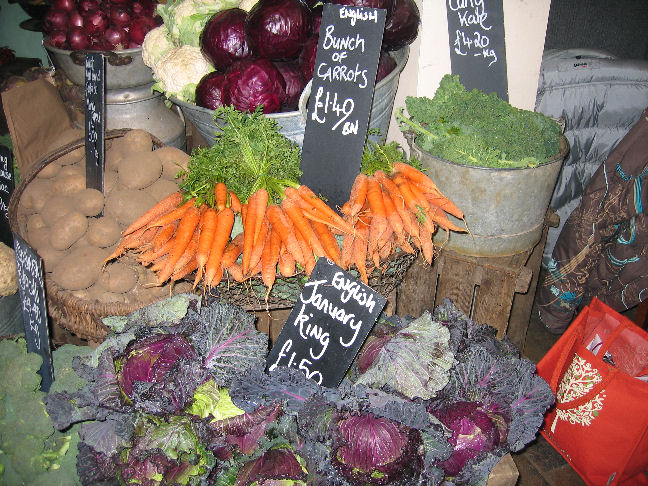
Bills cafe is famous for its fresh fruit and vegetables and delicious all day food served in the cafe.

I asked Bill on 23/7/2009 what he thought about having his recipes analysed to show their nutritional value. His reply went something like this:

‘Look love, we have specifications for our recipes, but we are creative here. See these tomatoes. Some of them need more salt than others and some need a hint of sweetness by adding honey. We don’t know until we are making the passata so the nutrition will change. We’re not like those big food chains where food goes into the factory all the same and comes out the same. Here we are different. If the supplier delivers different varieties of potatoes we cook them in ways which work best, and this changes the nutrition.  I’ve got one chef who makes the most spicy hummus and another that adds his own touch of flavour. We’re creative, and do things by taste and flavour.’

What about allergens Bill?

‘We know our recipes, so we know whether they contain wheat or milk. Nuts is a problem as everything is prepared in a small kitchen and we can’t guarantee nut free.’

Can I try and analyse one of your recipes Bill?

‘OK, I’ll sort one out – but I think taste matters, not the nutrition!’

Now in 2014 Bill could use our Food Labeller which does all of this online!

Cut down on your sugar!

Manufacturers have been asked to reduce sugar content of food to 5% of daily energy.

The previous guidance was 10% of daily energy, but 5% is in line with the World Health Organisation.
The report from the Scientific Advisory Committee  SACN is available online.

The recommended limits are

25g (5-6 teaspoons) of sugar for women

35 g (7-8 teaspoons) for men.

sugar

The report said sugary drinks such as fizzy drinks and squash should be reduced for children and adults.

Food Manufacture Magazine has an interesting audio presentation for this article.

’30% of teenager’s calories are coming from soft drinks’ says Dr Alison Tedstone, Public Health England’s chief nutritionist.

How can manufacturers reformulate products to contain less sugar?

Swap sugar for low sugar alternatives. Also reduce sugar content of drinks – people are adapted to sweet taste. Can do the same as salt reduction.

Consumption of sugary drinks increases childhood obesity. This includes fruit juice – contains the same amount as fizzy drink.

Public Health England is launching campaign to encourage sugar reduction.

Thinking about taxing sugary drinks, restricting advertising, and digital media.

The Nutrition Program can be used to show you the % of sugar in your products based on current RI recommended intakes.

Current recommendations for energy intakes are for 50% to come from carbohydrates in the form of starchy foods and whole grains.

Dr Ann Prentice, chair of SACN, said ‘There is strong evidence to show that if people have less free sugars and more fibre in their diet, they can lower the risk of cardiovascular disease, type 2 diabetes and bowel cancer.’