
For the Food Preparation Task you need to Cost a recipe, use the Method for your practical and analyse and Evaluate your results. Food Preparation book ready soon.
These screens have come from Nutrition Program.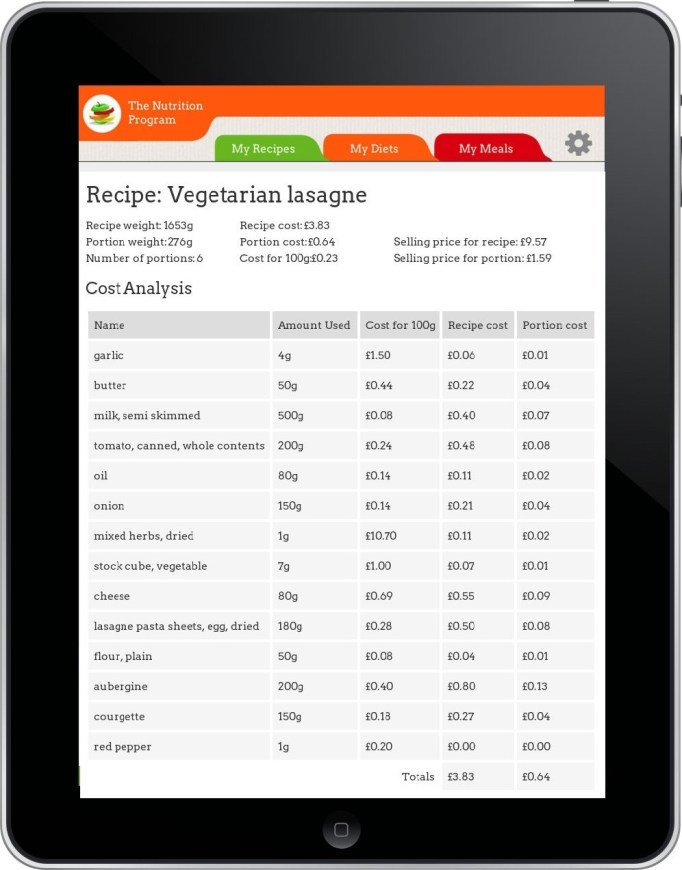


For the Food Preparation Task you need to Cost a recipe, use the Method for your practical and analyse and Evaluate your results. Food Preparation book ready soon.
These screens have come from Nutrition Program.
Factors affecting requirements
• Age – the RNI for vitamin C for a child aged 1 year and under is 25mg/d, and for an adult is 40mg/d
• Gender – the RNI for iron in women aged 19-50 years is 14.8mg/d, which is higher than for men (8.7 mg/d) to cover menstrual losses
• Growth – adolescents have higher calcium requirements to cover their bone growth
• Pregnancy and Lactation – The RNI for vitamin D in women that are pregnant or breastfeeding is 10 μg/d, whereas there is no RNI set for women of childbearing age who are not pregnant or breastfeeding.
| Infants | First 4-6 months of life (period of rapid growth and development) breast milk (or infant formula) contains all the nutrients required. Between 6-12 months – requirements for iron, protein, thiamin, niacin, vitamin B6, vitamin B12, magnesium, zinc, sodium and chloride increase. Department of Health advice recommends exclusive breastfeeding until 6 months of age with weaning introduced at 6 months. |
| 1-3 years | Energy requirements increase (children are active and growing rapidly). Protein requirements increase slightly. Vitamins requirements increase (except vitamin D). Mineral requirements decrease for calcium, phosphorus and iron and increase for the remaining minerals (except for Zinc). |
| 4-6 years | Requirements for energy, protein, all the vitamins and minerals increase except C and D and iron. |
| 7-10 years | Requirements for energy, protein, all vitamins and minerals increase except thiamin, vitamin C and A. |
| 11-14 years | Requirements for energy continue to increase and protein requirements increase by approximately 50%. By the age of 11, the vitamin and mineral requirements for boys and girls start to differ. Boys: increased requirement for all the vitamins and minerals. Girls: no change in the requirement for thiamin, niacin, vitamin B6, but there is an increased requirement for all the minerals. Girls have a much higher iron requirement than boys (once menstruation starts). |
| 15-18 years | Boys: requirements for energy and protein continue to increase as do the requirements for a number of vitamins and minerals (thiamin, riboflavin, niacin, vitamins B6, B12, C and A, magnesium,potassium, zinc, copper, selenium and iodine). Calcium requirements remain high as skeletal development is rapid. Girls: requirements for energy, protein, thiamin, niacin, vitamins B6, B12 and C, phosphorus, magnesium, potassium, copper, selenium and iodine all increase. Boys and girls have the same requirement for vitamin B12, folate, vitamin C, magnesium, sodium, potassium, chloride and copper. Girls have a higher requirement than boys for iron (due to menstrual losses) but a lower requirement for zinc and calcium. |
| 19-50 years | Requirements for energy, calcium and phosphorus are lower for both men and women than adolescents and a reduced requirement in women for magnesium, and in men for iron. The requirements for protein and most of the vitamins and minerals remain virtually unchanged in comparison to adolescents (except for selenium in men which increases slightly). |
| Pregnancy | Increased requirements for some nutrients. Women intending to become pregnant and for the first 12 weeks of pregnancy are advised to take supplements of folic acid. Additional energy and thiamin are required only during the last three months of pregnancy. Mineral requirements do not increase. |
| Lactation | Increased requirement for energy, protein, all the vitamins (except B6), calcium, phosphorus, magnesium, zinc, copper and selenium. |
| 50+ years | Energy requirements decrease gradually after the age of 50 in women and age 60 in men as people typically become less active and the basal metabolic rate is reduced. Protein requirements decrease for men but continue to increase slightly in women. The requirements for vitamins and minerals remain virtually unchanged for both men and women. After the menopause, women’s requirement for iron is reduced to the same level as that for men. After the age of 65 there is a reduction in energy needs but vitamins and minerals requirements remain unchanged. This means that the nutrient density of the diet is even more important. |
 The Eatwell Guide shows the different types of foods and drinks we should consume – and in
what proportions – to have a healthy, balanced diet.
The Eatwell Guide shows the proportions of the main food groups that form a healthy,
balanced diet:
• Eat at least 5 portions of a variety of fruit and vegetables every day
• Base meals on potatoes, bread, rice, pasta or other starchy carbohydrates; choosing
wholegrain versions where possible
• Have some dairy or dairy alternatives (such as soya drinks); choosing lower fat and lower
sugar options
• Eat some beans, pulses, fish, eggs, meat and other proteins (including 2 portions of fish
every week, one of which should be oily)
• Choose unsaturated oils and spreads and eat in small amounts
• Drink 6-8 cups/glasses of fluid a day
If consuming foods and drinks high in fat, salt or sugar have these less often and in small
amounts.
Regularly consuming foods and drinks high in sugar increases your risk of obesity and tooth
decay. Ideally, no more than 5% of the energy we consume should come from free sugars*.
Currently, children and adults across the UK are consuming 2-3 times that amount.
Sugary drinks have no place in a child’s daily diet but account for a surprisingly large proportion
of the daily sugar intake of both children and adults. Almost a third of the free sugars consumed
by 11-18 year olds comes from soft drinks. We should aim to swap sugary drinks for water,
lower fat milk or sugar-free drinks including tea and coffee. Be sure to check the label for added
sugar.
8 tips for eating well
1. Base your meals on starchy foods
2. Eat lots of fruit and veg
3. Eat more fish – including a portion of
oily fish each week
4. Cut down on saturated fat and sugar
5. Eat less salt – no more than 6g a day
for adults
6. Get active and be a healthy weight
7. Don’t get thirsty
8. Don’t skip breakfast
Article from The Times Body and Soul 22/8/2015
Vegetables are a source of Vitamin A and C, and minerals calcium and iron.
They also give phytonutrients – antioxidants thought to slow the effects of ageing of body and brain.
 Here are preparation tips to stop loss of nutrients:
Don’t eat salad with fat-free dressing
Why? More salad nutrients are absorbed when eaten with fat. Extra virgin olive oil contains the most phytonutrients. Green leafy veg are better stir fried with oil as it increases absorption of fat soluble vitamins – A,D, E, K.
Leave garlic for 10 mins before frying
Why? Allicin in garlic has anti-bacterial properties and heat inactivates it. By leaving it, it does its work.
Fresh or frozen?
Green beans lose 40% folic acid, zinc and vit C within 2 days. Frozen fruit and veg are chilled within hours of picking which locks in anti-oxidants which fight cancer. Farm to plate for other veg can take months so frozen can be best.
Buy whole head of broccoli not florets.
Why? Cutting destroys nutrients – anti-oxidants and phytonutrients break down by oxidation.
After 10 days – the time from field to shop – broccoli lost 75% flavonoids (anti-oxidants) and 80% glucosinolates – believed to stimulate the immune system. By freshest you can and cook straight away.
Buy canned tomatoes
Why? Cooking makes them more nutritious. Heat changes lycopene (antioxidant) so it can be absorbed. Canned tomatoes higher in phytonutrients. Tomato paste is even better. Lycopene found to protect against prostate cancer.
Use vegetable peelings
Peelings have a higher concentration of antioxidants than the rest of the vegetable so use them in cooking.
Don’t soak fruit and veg
Wash them to get rid of bacteria and pesticide residue. If you soak them, water soluble nutrients leach out. Parboil and rinse under the cold tap. Steaming, microwaving, sauteing and roasting don’t use water so are more nutritious.
Chill potatoes after cooking!
This changes the starch to a type that is digested more slowly, and contain more fibre for gut health.
Buy canned beans
Canned beans have more antioxidants than dried beans. If you prefer dried beans, let them sit in liquid for an hour after cooking to reabsorb some nutrients.
Carbohydrate values in McCance and Widdowson (M&W) series of publications are expressed as monosaccharide equivalents.
These values can exceed 100g per 100g of food because on hydrolysis 100g of a disaccharide, such as sucrose, gives 105g monosaccharide (glucose + fructose).

Thus white sugar appears to contain 105g carbohydrate (expressed as monosaccharide) per 100g sugar.
For conversion between carbohydrate weights and monosaccharide equivalents, the values shown in Table 1 below (adapted from M&W introduction) should be used.
In trying to explain this to students (depending on the age) you could explain this using chemistry and molecular weights:
Sucrose + water → glucose + fructose
C12H22O11 + H2O → C6H12O6 + C6H12O6
342g + 18g → 180g +180g
So in this example you can see 342g of the disaccharide sucrose gives 360g monosaccharides.
| Table 1
|
Conversion of carbohydrate weights to monosaccharide equivalents
|
||
| Carbohydrate | Equivalents after
hydrolysis g/100g |
Conversion to
monosaccharide equivalents |
|
|
Monosaccharides e.g. glucose, fructose and galactose |
100 |
no conversion necessary |
|
|
Disaccharides e.g. sucrose, lactose and maltose |
105 |
x 1.05 |
|
|
Oligosaccharides e.g. raffinose (trisaccharide) stachyose (tetrasaccharide) verbascose (pentasaccharide) |
107 108 109 |
x 1.07 x 1.08 x 1.09 |
|
|
Polysaccharides e.g. starch
|
110
|
x 1.10 |
|
 The Nutrition Program Blog