
Cooking cakes – the ingredients

Cooking cakes – ingredients matter

What happens if I leave things out?

In this experiment you make a batch of small sponge cakes.

Each time you leave one ingredient out and see what happens.

Why do I need to do that?

If you leave an ingredient out, the look and the taste of the cake changes.

This picture shows sponge cake with no egg, no fat, no baking powder
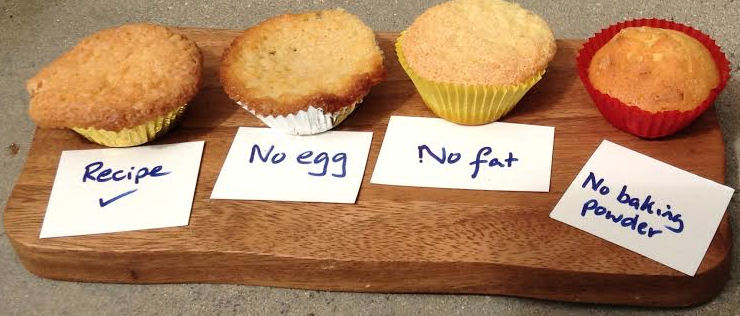
Cakes with ingredients missing

What to do

Make 4-5 batches of sponge cakes – each batch has an ingredient missing.

Sponge cake basic recipe – makes 6 cakes

60 g margarine
60 g caster sugar
1 egg, beaten
60 g plain flour
1 level teaspoon baking powder
Method
Preheat the oven to 180C.
Beat the margarine and sugar together until creamy.
Beat in the egg and stir in the sieved flour and baking powder until smooth.
Spoon equal amounts into 6 baking cases and bake for 20 -25 minutes until firm and golden.
Cool on a wire rack.

Leave out the egg
Follow the basic recipe but replace the egg with 60 ml (60g) water.
Share into 6 baking cases and bake in the same way.
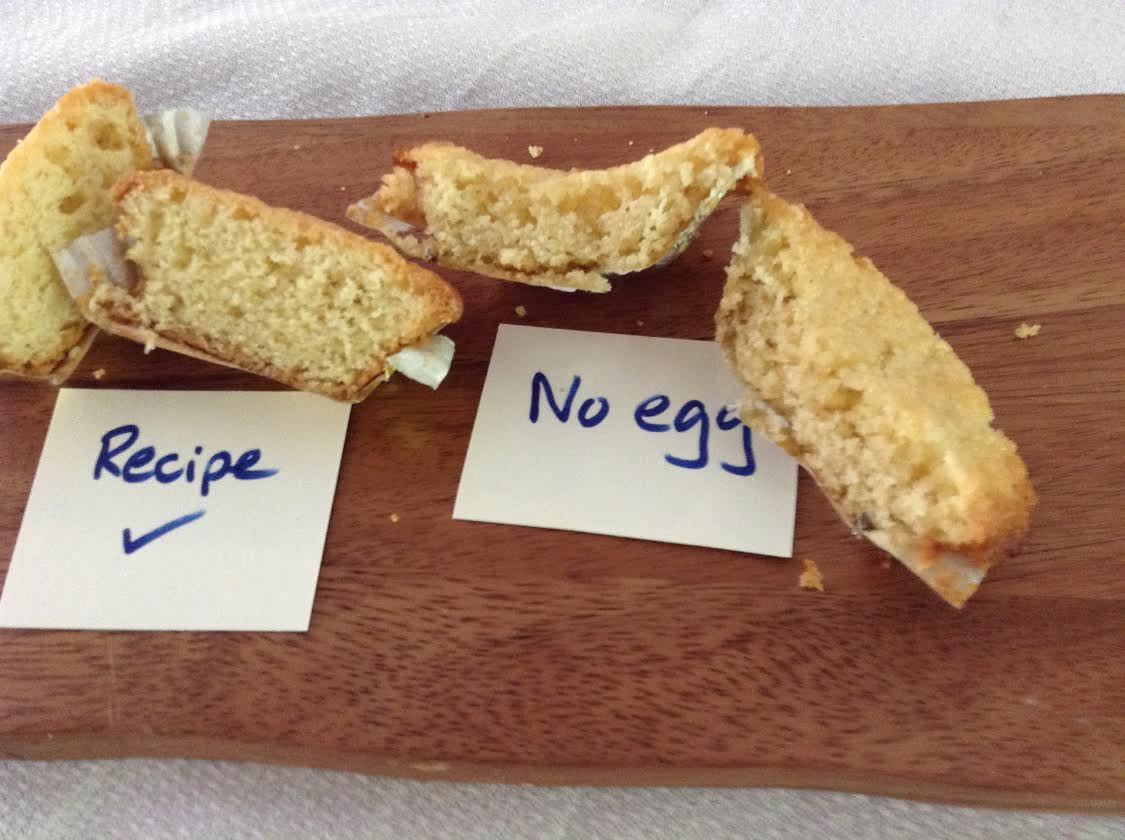
cake no egg

Leave out the fat – margarine
Mix together the sugar, flour, baking powder and egg to a batter.

Spoon into 6 baking cases and bake in the same way.
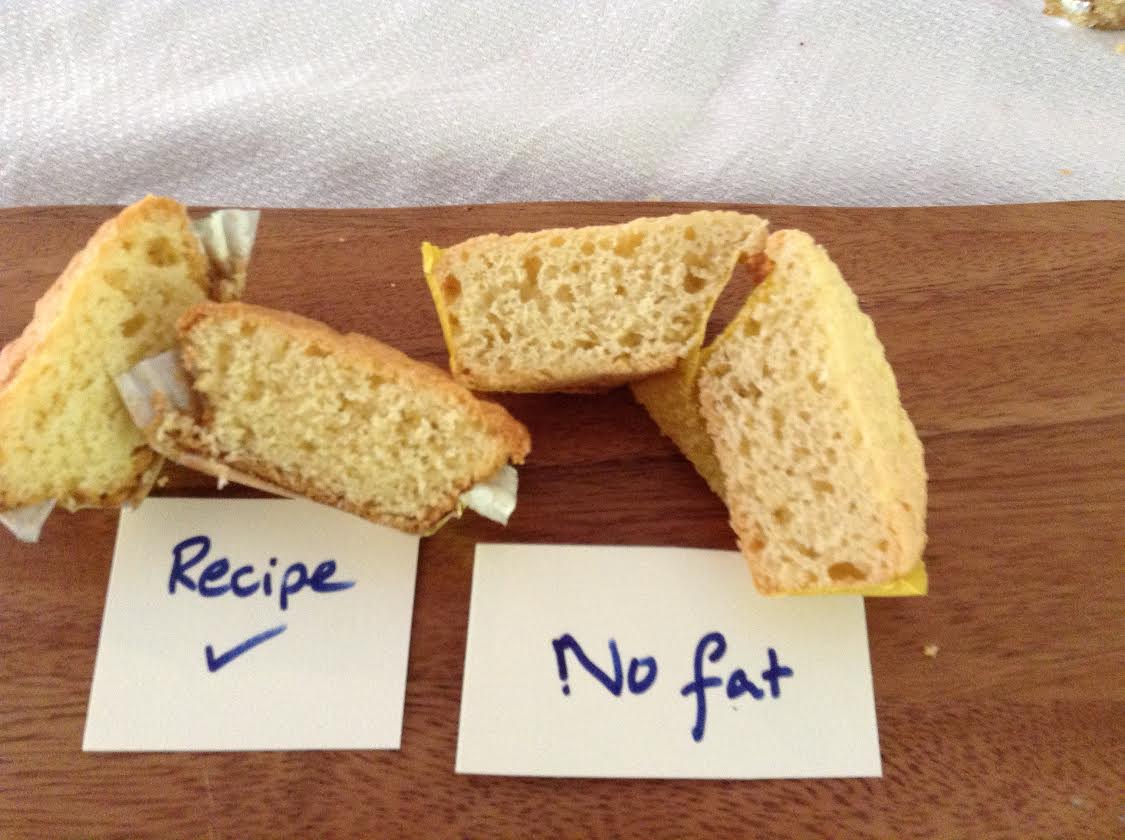
cake no fat

Leave out the baking powder
Make the same as the basic recipe but don’t add the baking powder.

Share into 6 baking cases and bake in the same way.

Leave out the sugar
Mix the margarine, flour and baking powder together.
Share into 6 baking cases and bake in the same way.

Use the chart to compare results

Cake Flavour Texture
Basic recipe Buttery, sweet, delicious Spongy with air bubbles and well risen
No egg Sweet and buttery but difficult to eat Dough collapses in middle and is stringy
No fat Dry and sweet but not delicious Spongy and light, but tough
No baking powder Sweet and firm, buttery Firm and rather hard
No sugar No sweetness or butteriness Hard and chewy

What does each ingredient do?
Work it out from the change in flavour and texture of the cakes.

Ingredient in cake What does it do?
Egg
Margarine – fat
Baking powder
Sugar

Of course I didn’t try and cook a cake without flour!

Free 14 Allergen card to download

We’ve designed a free14-Allergens-Posterfor you to download and print off to use to help identify the allergens in your recipes and menus.


14 allergens that must be labelled

The Nutrition Program identifies the allergens in your recipes and shows them on the Food Label.

The Nutrition Program lists the allergens in ingredients.
When you create a recipe the Food Label shows the allergens in a recipe like this Cheese and Onion Pasty.


McCance and Widdowson’s The Composition of Foods 7th Edition

McCance and Widdowson’s (7th edition) – we will implement the 7th Edition into our database when available as a downloadable database.

The Composition of Foods, Seventh Summary Edition MW7 is prepared by IFR Institute of Food Research and the FoodComp team for publication by RSC Royal Society of Chemistry – September 2014

Updates and changes in McCance and Widdowson’s The Composition of Foods, Seventh Summary Edition MW7

  •       All data have been extensively reviewed – scientists have compared and added new industry data, new analytical data and recalculated all recipes. They have also reviewed and revised the list of foods contained in MW7 to reflect commonly consumed foods in the UK
  •       New data from analytical surveys includes foods in the following groups: flours and grains, bread, pasta, breakfast cereals, biscuits, cakes, eggs, fat spreads, fruits, vegetables and fish and fish products.
  •       The tables now include AOAC – scientists have analysed values for all new analytical data.  The edible conversion factor has been removed and replaced into a table in the back of the book.  In its place is a column to describe the main data reference (including year of analysis).
  •        The online Integrated Dataset (containing all foods) will be updated to coincide with the MW7 release.

There are also entries for many foods that have become popular in recent years such as fresh pasta and creme fraiche.

creme fraiche

The Seventh Edition is currently being prepared by IFR Institute of Food Research and the FoodComp team for publication by RSC Royal Society of Chemistry

UK FoodComp is a 4 year project to update CoFIDS – the Composition of Foods.


Online UK Composition of Foods Integrated Dataset (CoFIDS)

The Food Standards Agency (FSA) maintains the UK Nutrient Databank, with information on the nutrient content of foods commonly consumed in the UK.

The McCance and Widdowson’s The Composition of Foods (CoF) book series, i.e. the 6th Summary Edition and supplement publications, contains nutrient composition data based on information from this databank.

The CoF IDS lists analytical nutrient data for 3,423 foods. The data are divided across 16 worksheets and include nutrient data for macronutrients, vitamins, vitamin fractions, minerals, fatty acid fractions, phytosterols, and organic acids, as well as providing recalculated values for a selection of foods in the format required for nutrition labelling.


Any enquiries regarding the use and re-use of this information resource should be emailed to:psi@nationalarchives.gsi.gov.uk

Recent FSA analytical surveys

Thirty-two composite samples were analysed for energy and a range of nutrients including fat, protein, carbohydrate, fibre and a full range of vitamins and minerals. Foods analysed were farmed and wild salmon, quiche, cook-in sauces, stir fry sauces, American muffins, Jaffa Cakes, coffee, sushi, vegetarian mince, rice cakes, premium chilled carton soups, potato wedges, vegetable curry (ready meal) and cake bars. Nutrient levels were in line with those found previously in other, similar foods.32foodsfromfoodstandards

Technical guidance on the nutrition provisions of Regulation (EU) No. 1169/2011 on the provision of food information to consumers (EUFIC), and to our guide to the (voluntary) UK front of pack labelling scheme announced in June

Frontofpack

Frontofpack2

The EU FIC text can be found at:

NHS Choices webpage on food labels

http://www.fdf.org.uk/understanding-food-information-regulation-event-sep13.aspx

Cut down on your sugar!

Manufacturers have been asked to reduce sugar content of food to 5% of daily energy.

The previous guidance was 10% of daily energy, but 5% is in line with the World Health Organisation.
The report from the Scientific Advisory Committee  SACN is available online.

The recommended limits are

25g (5-6 teaspoons) of sugar for women

35 g (7-8 teaspoons) for men.

sugar

The report said sugary drinks such as fizzy drinks and squash should be reduced for children and adults.

Food Manufacture Magazine has an interesting audio presentation for this article.

’30% of teenager’s calories are coming from soft drinks’ says Dr Alison Tedstone, Public Health England’s chief nutritionist.

How can manufacturers reformulate products to contain less sugar?

Swap sugar for low sugar alternatives. Also reduce sugar content of drinks – people are adapted to sweet taste. Can do the same as salt reduction.

Consumption of sugary drinks increases childhood obesity. This includes fruit juice – contains the same amount as fizzy drink.

Public Health England is launching campaign to encourage sugar reduction.

Thinking about taxing sugary drinks, restricting advertising, and digital media.

The Nutrition Program can be used to show you the % of sugar in your products based on current RI recommended intakes.

Current recommendations for energy intakes are for 50% to come from carbohydrates in the form of starchy foods and whole grains.

Dr Ann Prentice, chair of SACN, said ‘There is strong evidence to show that if people have less free sugars and more fibre in their diet, they can lower the risk of cardiovascular disease, type 2 diabetes and bowel cancer.’

Vegetarian Food labelling

Labels for  vegetarian and vegan are voluntary.

Food Labelling 2004 Regulations state that all Compound ingredients used in a product – such as sponge fingers in a trifle – must list their ingredients. Except jam, chocolate, mixed herbs and spices, and ingredien
ts that are less than 2% of finished product.

But allergens must be shown such as sesame, gluten, eggs.

The term vegetarian must not be used for foods that are made from dead animals.

The term vegan cannot be used for foods that are made from dead animals or from products from living animals – for example, milk.

The Vegetarian Society and Vegan Society provide useful information and on additives, processing aids and flavourings.

Products made from living animals include milk, eggs, honey, bee pollen.

Products made with the help of these products include cheese made with rennet, yogurt made from gelatine, whey, additives, flavourings and carriers such as lecithins.