
This is the Youtube link
Slide show for Marmite on toast
This is the Youtube link
This is the Youtube link
These are the Hover overs used on the Nutrition Program to help you find the function of nutrients.
Energy – Measured in KJ and Kcal. Needed to keep us alive and active.
Protein – Needed for growth and repair, a source of energy.
Carbohydrates are a source of energy.
Total sugars are all types of sugar in food. A source of energy.
Fat – good source of energy and supplies essential fatty acids that the body can’t make.
Saturated fat – Too much saturated fat can increase the cholesterol in the blood.
Mono Unsaturates – These types of fats can reduce cholesterol levels.
Polyunsaturates – These types of fats can reduce cholesterol levels.
Cholesterol – High blood cholesterol is one of the risk factors in heart disease.
Trans fatty acids – These raise the type of cholesterol in the blood that increases the risk of heart disease.
Starch – Polysaccharide made up of glucose units. Used for energy.
Salt – Essential for cells and control of body fluids. Limit intake to 6g a day.
Sodium – Salt is made from sodium chloride.
Total sugars – All types of sugar in the food.
Fibre – Needed to keep the gut healthy and prevent constipation. Non Starch polysaccharide – needed for healthy digestive system.
NSP Fibre Non Starch polysaccharide – needed for healthy digestive system.
AOAC Fibre – Fibre measurement AOAC includes lignin and resistant starch – higher figure than NSP.
Fat soluble vitamins A and D, E
Vitamin A – Needed for growth, development and eyesight. Retinol and Carotene
Vitamin D – Regulates the amount of calcium and phosphate in the body.
Vitamin E – Helps protect cell membranes by acting as an antioxidant.
Water soluble vitamins -B1 (thiamine), B2 (riboflavin),B3 (niacin),B6 (pyridoxine)
Vitamin C – Needed for healthy skin and tissue, and to aid the absorption of iron. Ascorbic acid
Thiamin – Needed for the release of energy from carbohydrates.(B1)
Riboflavin – Helps release energy from carbohydrates.
Niacin – Needed for the release of energy from carbohydrates.
Vitamin B6 Pyridoxine – essential for good health and red blood metabolism.
Folate – Prevents neural tube defects in developing embryos. (B9)
Minerals – calcium, iron, sodium, phosphorus, iodine,
Calcium Helps build strong bones and teeth.
Iron Helps make red blood cells, which carry oxygen around the body.
Phosphorus Helps build strong bones and teeth.
Iodine – Helps make the thyroid hormones and keep metabolic rate healthy.
Pea and mint soup
Serves 2
80g of peas provides you with a portion of your 5 a day.
Ingredients
200g frozen peas
mint leaves
salt and black pepper
500 ml whole milk
50g creme fraiche
Method
Heat the frozen peas, mint and milk until just boiling then leave to cool.
Whizz in a food processor to make a smooth sauce. Season with salt and pepper.
Stir in the creme fraiche – but leave a small blob for serving.
Garnish with croutons.
Vitamin A is measured using Retinol Equivalents (RE). The contribution of both retinol and beta-carotene is used to determine the total vitamin A content of a specific food.
Vitamin A can be calculated from its content of retinol and beta-carotene and its derivatives, based on the following formula:
total vitamin A (RE) = µg of retinol + ( µg of beta-carotene ÷ 6)
International Units (IU) were formerly used to express the vitamin A content of a food. To convert IU of vitamin A into Retinol Equivalents, the following formulae are used:
IU retinol÷3.33 = RE
IU beta-carotene ÷ 10 = RE
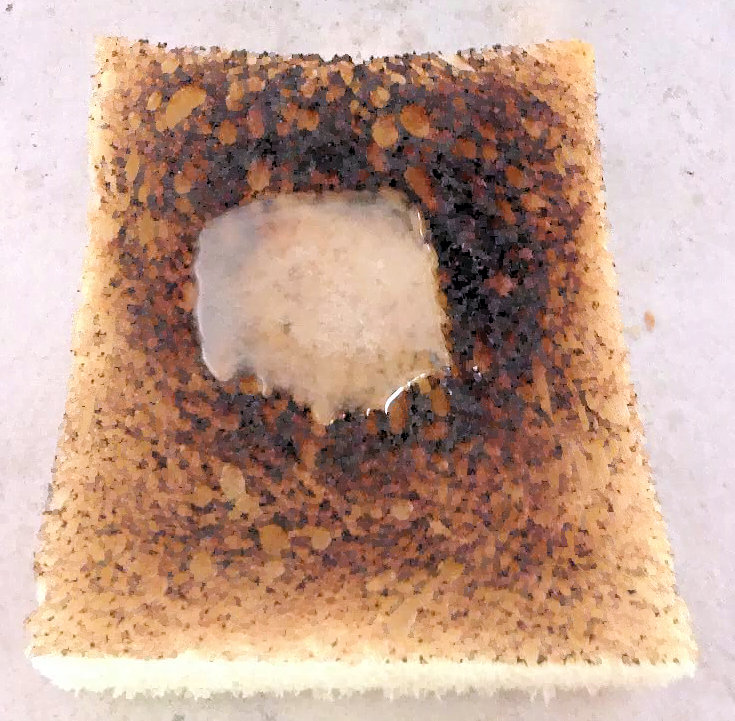
Burnt toast
You can’t really eat this experiment but it shows the difference between dextrinisation and caramelisation.
You need
A piece of white bread
A teaspoon of icing sugar mixed with a tiny, tiny amount of water
Either a grill or a blow torch – which is more fun!
A baking tray
What to do
Put the slice of bread on a baking tray and drop a blob of the icing mixture on the middle.
Grill the bread and sugar or burn with a blow torch until the bread changes colour.
Watch the changes in the bread – dextrinisation – and the sugar – caramelisation.
Don’t eat the toast until the caramelised sugar is cool!
The toast should taste slightly sweet – dextrin – and the sugar will taste like toffee.
The science bit
When dry starch is heated – like the flour in bread, a brown substance called dextrin is formed.
The food goes through a chemical reaction where starch breaks down into dextrin which is a slightly sweet, brown substance.
Caramelisation is the process of cooking sugar until it turns brown. All sugars caramelise.
Creme brulee is made by caramelising the top layer of sugar on a custard.
 The Nutrition Program Blog