How is food analysed for nutrients?

To get the nutritional data for a range of food, samples are analysed as shown below. The market share of consumption of that group of foods such as fruit and vegetables in the UK is taken.

From the surveys done between 1982 and 1990, the results of 2013 were very similar but new types of fruit and vegetables have been introduced.

This is how the main nutrients are analysed:

Protein – Leco instrument and Dumas procedure.

The sample is combusted in oxygen, and the nitrogen is measured. Protein can be worked out with a special formula.

Fat –The sample is hydrolysed in hydrochloric acid and fat is extracted and measured.

Sugars

sugar_1kg

Extracted with water and chromatographically separated and then calibrated.

Dietary fibre – 2 methods for different types of fibre

AOAC

The sample is defatted then gelatinised and treated with an enzyme to remove starch and protein. The dietary fibre is dried and weighed.

Englyst NSP Non starch polysaccharides

Englyst Fibrezym kit is used with colorimetric end point.

Changing sodium to salt

We are told to cut down on salt but sodium is listed on food labels so how do we convert?

To reduce risk of high blood pressure need to limit to 6g of salt a day.

High salt >1.5g per 100g

Low salt < 0.3g per 100g

Watch out for baking powder!

Age Salt intake
1-3 years 2g
4-6 years 3g
7-10 years 5g
11 years and over 6g

Sodium to salt

To convert sodium (mg)  to salt (g), multiply the sodium figure in milligrams (mg) by 2.5 and then divide by 1,000.

So: millgrams of sodium X 2.5 = milligrams of salt ÷ 1,000 = grams of salt

500 mg sodium x 2.5 / 1000 = 1.25 grams salt

In reverse

grams of salt x 1000 /2.5 = mg of sodium

1.25 grams salt x 1000 /2.5 = 500 mg sodium or 0.5 g sodium

Eating too much salt increases your risk of developing high blood pressure which is a major risk factor for heart disease.

Too much salt is harmful to health

Too much salt is harmful to health

 News Flash – Food labelling is changing

By December 2014 all food labels will only list salt -sodium will not be listed. This will make it much easier for you to see how much salt each product contains. So we must change the Nutrition Program to fit in with this.

 Choose lower salt options using the following guidelines on food labels:

A food high in salt has more than 1.5g salt per 100g (or 0.6g sodium).

Reference Intake RI s on food labels

The voluntary UK front of pack Nutrition Labelling Scheme launched on 19/6/2013 uses Reference Intake information RI –  this was known as Guideline Daily Amount (GDA).

It shows levels of energy, fat, saturates, sugar and salt in red, amber or green if the traffic light system is used. Adult values only for average sized woman.
The Nutrition Program only shows adult values on food labels in line with this UK labelling scheme.
Reference intakes are based on an average-sized woman doing an average amount of physical activity.

RIs for fat, saturates, sugars and salt are the maximum amounts that should be consumed in a day.

Reference intakes

These are the figures currently used on most FoP (Front of Pack) labels and are adult values, based on an average sized woman, doing an average amount of physical activity.

New Food Label 2013

New Food Label 2013

Food Preparation and Nutrition GCSE – nutritional information on recipes for students

The Nutrition Program follows the rules for Reference Intake set out by the Department of Health, Food Standards Agency and other agencies.
Since 2014 RI on food labels only shows the RI for an adult woman.In the past whe n we used GDAs we showed men, women and a child of 5-10 years old.
Hidden in the Program if you click My Recipes – go to your recipe/ Nutrition/ Show 8 you see the table of nutrients.
At the bottom of the screen there is a green box withe Reference Intake. Click that and you will see old RI/GDA data for a child 5-10 years old.

If students are analysing each dish they can’t technically use RI for children as the data does not exist.
Instead go to My Meals and call the meal ‘Apple PIe’ or something. Choose the age and sex of the child and the meal type.
Choose the recipe you want the data for – say Apple pie and it adds one portion.
Go to Nutrition and it will show you Basic Nutrients and All nutrients and give you a good idea of how nutritious the dish is for a child.

Technically the RI is only for an adult woman.The RIs are defined in a new piece of legislation called the Food Information to Consumers Regulation. Download the document on this link.

The Regulation provides RIs for use on a label for Energy kJ, kcal, fat, saturates, (total) sugars and salt and these are the same as the current ‘adult’ GDA values, with the exception of protein which has changed from 45g to 50g and carbohydrate which has changed from 230g to 260g.

RIs (part B of Annex XIII of EU FIC – see Table 1 below).

Note: When re-labelling to meet the requirements of EU Regulation 1169/2011, you must use the RIs set out in the Regulation.

There is no provision in the Regulation for the use of Children’s RIs.

The European Commission and Member States have powers to adopt rules setting RIs for “specific population groups” (including children), but have yet to do so.

Reference intakes (EU FIC Annex XIII part B) for FoP nutrition labels

Energy (kJ)

8,400

Energy (kcal)

2,000

Fat

70g

Saturates

20g

Sugars

90g

Salt

6g

In addition the following statement must appear close to where information on Reference Intakes are given ‘Reference Intake of an average adult (8400kJ/2000kcal’).

The new Regulation can be found at: http://eur-lex.europa.eu/LexUriServ/LexUriServ.do?uri=OJ:L:2011:304:0018:0063:EN:PDF

Save

Save

Save

Save

Traffic light labels

The Nutrition Program creates a traffic light label for your recipes which show whether a food has a high (red), medium (amber) or low (green) level of fat, saturated fat, salt and sugar. They make it easy to compare foods and see which is healthier. If you choose a food that is high in fat one day, you can balance it with one that is low another. Most supermarkets are using this system of labelling to help their customers make healthy choices.

New Traffic light labelling for 2014

Links to Eatwell site

Information needed:• Amounts of fat, saturates, total sugars and salt per 100g/ml for a product. Portion size criteria apply to portions over 100g.

Table 2: Criteria for 100g of food (whether or not it is sold by volume)

Text


LOW


MEDIUM


HIGH


Colour code


Green


Amber


Red

Fat

3.0g/100g

> 3.0g to

17.5g/100g

> 17.5g/100g

> 21g/portion

Saturates

1.5g/100g

> 1.5g to

5.0g/100g

> 5.0g/100g

> 6.0g/portion

(Total) Sugars

5.0g/100g

> 5.0g and

22.5g /100g

> 22.5g/100g

> 27g/portion

Salt

0.3g/100g

> 0.3g to

1.5g/100g

>1.5g/100g

>1.8g/portion

This was the previous traffic light labelling

traffic light older info

Food labelling changes Dec 14th 2014

A new food labelling law and a new government front-of-pack nutrition labelling scheme is coming into force.

This new regulation considerably changes existing legislation on food labelling, standardising nutrition information on processed foods.

It will include new legislation for both prepackaged and non prepacked foods including food sold in restaurants and cafés

The new rules will apply from 13 December 2014. The obligation to provide nutrition information will apply from 13 December 2016

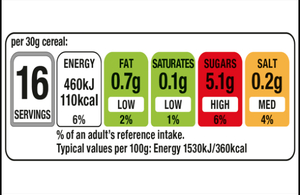
New traffic light label for Front of Pack

new food label

The front of pack labels will include information on the percentage of Reference Intake (RI) with traffic light colours – green, amber, red.

The lozenge label shows if products have high (red), medium (amber) or low (green) amounts of fat, saturated fat, salt and sugar.

For healthy eating choose foods with greens and amber and go easy on the reds.

Labelling changes

  • Reference Intake (RI) is replacing Guideline Daily Amounts (GDA)
  • Energy as calories and kilojoules are no longer colour coded.
  • Kilojoules (kJ) are shown with calories (kcal) on front of packs and shown as 100g and per portion.
  • The order of nutrition information on the nutrition table is changing.
  • Sat fat is replaced with saturated fat, sugars are used instead of sugar, salt is shown instead of sodium.
  • The government criteria for the traffic light colours has changed.

Reference Intakes are a guide to the maximum amounts of calories, fat, saturates, sugars and salt an adult should consume in a day (based on an average female adult). They were formerly known as Guideline Daily Amounts (GDAs).

Reference intakes (EU FIC Annex XIII part B) for FoP nutrition labels7

Energy (kJ)  8,400
Energy (kcal)  2,000
Fat   70g
Saturates   20g
Sugars   90g
Salt    6g

The calculations for arriving at the correct % RI for each nutrient and energy are as follows:
𝐴𝑚𝑜𝑢𝑛𝑡 𝑜𝑓 𝑛𝑢𝑡𝑟𝑖𝑒𝑛𝑡 𝑝𝑒𝑟 𝑝𝑜𝑟𝑡𝑖𝑜𝑛 /𝑅𝐼x100= %RI
𝐸𝑛𝑒𝑟𝑔𝑦 𝑣𝑎𝑙𝑢𝑒 𝑝𝑒𝑟 𝑝𝑜𝑟𝑡𝑖𝑜𝑛 𝑜𝑟 100𝑔 𝑜𝑟 100𝑚𝑙/RI 𝑥 100 = % 𝑅𝐼 𝑥 100

RIs for fat, saturates, sugars and salt are the maximum amounts that should be consumed in a day. These are the figures currently used on most FoP labels and are ‘adult’ values, based on an average sized woman, doing an average amount of physical activity.

Traffic light labels help you to balance your diet. Sainsbury’s has a brilliant website on this.

How do I know if a food is high in fat, saturated fat, sugar or salt?

There are guidelines to tell you if a food is high in fat, saturated fat, salt or sugar, or not. These are:

Total fat
High: more than 17.5g of fat per 100g
Low: 3g of fat or less per 100g

Saturated fat
High: more than 5g of saturated fat per 100g
Low: 1.5g of saturated fat or less per 100g

Sugars
High: more than 22.5g of total sugars per 100g
Low: 5g of total sugars or less per 100g

Salt
High: more than 1.5g of salt per 100g (or 0.6g sodium)
Low: 0.3g of salt or less per 100g (or 0.1g sodium)
Back of pack
The provision of nutrition information on the back of packs will become compulsory in the near future and there will be some small changes to the format required. It covers all aspects of food labelling, including the size of the letters on packaging. By the end of 2016, providing nutrition information on the back of packaged foods will be compulsory. The format of nutrition labels, on the back of pack, will change slightly under the new rules, including the order and type of nutrients displayed

Front-of-pack labelling, such as the traffic light labelling or RIs, will remain optional.

Clearfoodlabelling