What is a Hypothesis?

These are definitions taken from GCSE Science which are very useful to use for Food Preparation and Nutrition GCSE NEA 1
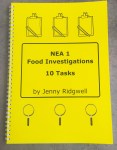
NEA 1 Book for 10 tasks

A Hypothesis is

  • A statement which may be proved or disproved.
  • A prediction backed up with a scientific reason saying why you think the prediction is correct.

You are

  • Predicting what the outcomes of experiments will be.
  • Using food science words to explain the prediction.
  • Investigating how ingredients work and why.
  • Writing what you think will happen in the Investigation

My views on Food Science Investigations

Students have 8-10 hours for the Investigation – see Exam board requirements.

I have given a spectrum of ideas that can be explored, but there is much more science that can be discovered.
Higher levels for the science investigation are required for the top grades.

The Book and the Powerpoint show realistic Investigations that can be carried out for GCSE within the limits of the school food room.
I’ve chosen foods for investigations that are not expensive, as experiments can fail and food must be thrown away – a mixed message on food waste.  
So there are challenges ahead!

Good luck with the Investigations. Jenny Ridgwell

Genetically Modified maize – for the popcorn lesson

Genetically modified maize was grown for the first time in the US and Canada in 1997.

Is it GM?

Maize is the only GM crop that is commercially grown in the EU. It’s used for feeding livestock and for the starch industry.
GM maize has insect resistance and herbicide tolerance.Now, about 80 per cent of the maize produced in the US is genetically modified.

GM EU maize is resistant to the corn borer which chews through maize stalks so the plant tips over.

EU GM maize cannot be mixed with conventional maize and food and feed made from GM maize must be labelled.

Maize starch is used for corn syrup, glucose and dextrose, modified starch and sugar substitutes.

What about GM foods and UK?

GM crops enter Britain mainly as animal feed. There is no commercial growing, but there have been experimental trials of GM potatoes, wheat and flax.

GM Maize is suitable for England.

Organic food has to be GM free.

A reported 70% of US supermarket processed food contains GM.

Do UK supermarkets sell GM foods? Difficult to know – by EU law it should be on the label.

Waitrose  No food is genetically modified.  Popcorn lovers day 


Fats and Nutrition

UK government guidelines advise cutting down on all fats and replacing saturated fat with some unsaturated fat.

Try this worksheet using the Nutrition Program for foods high in fat, sugar and salt.

A small amount of fat is an essential part of a healthy, balanced diet.
Fat is a source of essential fatty acids such as omega-3 – essential because the body can’t make them itself.

Fat helps the body absorb vitamins A, D and E. These vitamins are fat-soluble, meaning they can only be absorbed with the help of fats.

All types of fat are high in energy. A gram of fat, whether saturated or unsaturated, provides 9kcal of energy.

Most fats and oils contain both saturated and unsaturated fats in different proportions.

Saturated fats are found in many foods, both sweet and savoury.

Foods high in saturated fats include:

  • fatty cuts of meat
  • meat products, including sausages and pies
  • butter, ghee and lard
  • cheese, especially hard cheese
  • cream, soured cream and ice cream
  • some savoury snacks and chocolate confectionery
  • biscuits, cakes and pastries
  • palm oil
  • coconut oil and cream

Saturated fat guidelines

  • The average man should aim to have no more than 30g of saturated fat a day.
  • The average woman should aim to have no more than 20g of saturated fat a day.
  • Children should have less.

Food labelling

  • high fat – more than 17.5g of fat per 100g
  • low fat – 3g of fat or less per 100g, or 1.5g of fat per 100ml for liquids (1.8g of fat per 100ml for semi-skimmed milk)
  • fat-free – 0.5g of fat or less per 100g or 100ml

Saturated fat

  • high in sat fat – more than 5g of saturates per 100g
  • low in sat fat – 1.5g of saturates or less per 100g or 0.75g per 100ml for liquids
  • sat fat-free – 0.1g of saturates per 100g or 100ml

What’s happened to margarine?

Where has margarine gone? In the 1970’s when I taught cooking in east London we only used margarine and the Stork home economists came into school and showed us the all in one cake and sauce. Now Stork is called Stork original spread and is labelled 70% Vegetable Fat Spread.


Have I missed something!!! Stork is just labelled Perfect for Pastry or Perfect for cakes.


So you can’t buy margarine in a shop any more so what fat am I supposed to suggest as a butter alternative without advertising the brand???

There is a European Margarine Association  telling me that margarine has been around for nearly 150 years and that I must visit www.spreadthewordaboutmargarines.org

They say ‘Margarine comes in 3 forms: soft and spreadable margarines (in tub), liquid cooking blends (in bottle) and hard blocks that are great for baking (in wrapper)’

But type ‘margarine’ into a supermarket website and no products are listed as margarine.

Margarine and Spreads Association  but that leads me to The Art of Home Cooking which is an ancient Stork book – so has Margarine disappeared?

I will Tweet