Dahl – it takes skill – Monisha Bharadwaj

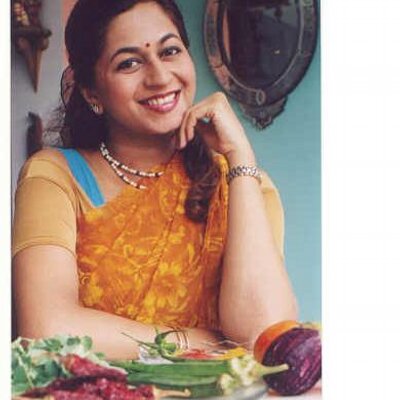
Monisha BharadwajI met Monisha Bharadwaj on a Guild of Food Writer’s Food Trip to Hampshire with Hampshire Fare and it was the perfect time to ask about dahl. I’ve struggled to make dahl that tastes and looks delicious, yet exam boards seem to think is is a low level skill. Wrong! But why not ask the expert?

Monisha is an Indian Chef, TV chef, food writer, author and cookery teacher and she knows a lot about cooking dahl, rice and raita.

Jenny – Do you think dahl is simple dish to make?
Monisha – ‘You’ve got to have a lot of skills to make dahl.  You need to know about sequence, proportion, balance and cooking time. How to cook the lentils properly to get the consistency right – getting the balance of spices and seasoning. There are many kinds of lentils and you need to know which type and colour to choose. Do you soak the lentils beforehand?

How long will you cook them to get the consistency you need – how thick or soupy should it be?

You need to get the spices and seasoning right to get the 6 tastes at the heart of Indian cooking – sweet, sour, salty, hot, bitter and astringent. For hot we use chilli, mustard and ginger. For bitter turmeric and cumin and for astringent turmeric and coriander.

Jenny – So how is dhal made?

Monisha – You need a high temperature frying oil to cook seeds, then onions, ginger and garlic.

Then add tomatoes, spice powder and lentils and cook with water until the lentils are soft. Taste and season with salt. Cook further if the lentils need to be softer.

Serve topped with coriander leaves.

Jenny – ‘When serving with rice – is that easy to cook?’

Monisha – ‘Cooking rice takes skill – knowing what rice to buy, what proportion of water to rice to use, the cooking time, draining and how to get it fluffy.’

Jenny – ‘So how do you cook rice?’

Monisha – ‘I wash the rice, fry spice seeds, add the rice and add 2 times the water by volume. Boil then reduce the heat, cover and cook for 10 minutes. Then leave for 5 minutes to fluff.

Jenny – ‘ Then serve with raita?’

Monisha – ‘Yes you can make it with grated cucumber, salt and pepper and plain yogurt.’

Jenny – ‘So Dahl, boiled rice and raita need high skills all round! Thanks’

Save

Save

Save

Save

Save

Save

Save

Save

Save

Save

Save

Save

Thoughts on Food GCSE 2016 Practical by Jenny Ridgwell

The exam boards are busy finalising their teacher’s support resources for the Food Practical 2018 exam and I think it is fundamentally flawed.

Why? 3 reasons.

A 3 hour practical is too long to make 3 dishes. As a consequence, students are expected to make dishes that are too complicated and irrelevant for today’s cooking in order to fill the exam time.

Exam boards are busy listing dishes according to the ‘level of skill’ – high, medium or low. So students, pushing themselves to do well, will practise dishes that are too complex for modern, multicultural living. Examples given for high skill are lemon meringue pie with piped meringue, cream horns made from home made flaky pastry – a dish high in fat and sugar – and veloute sauce. Daft, too difficult and unnecessary work.

Someone needs to learn to respect the high level skill for making delicious food and serving it well cooked and looking attractive.

Someone needs to acknowledge that we live in a diverse multicultural and teenagers don’t need to cook so many pastry dishes and cakes. I find falafel served with tsaziki, salad and warm pitta bread a really hard dish to make, yet this is a low level skill. Think how hard it is to make a good curry and cook fluffy rice.

Teachers are encouraged to teach how to make pasta – great for fun, and delicious to eat. But what happens if 8 pupils taking the 3 hour exam all want to make pasta with the school’s only pasta machine? Isn’t such a demand putting great financial pressure on food rooms that already struggle balancing the books?

When I started teaching in 1970, my inner London students had to learn how to make shortcrust, rough puff, flaky and choux pastry – all high fat, complex dishes and during hot summer months the results were awful. We made jam puffs, Eccles cakes and cream horns packed with hydrogenated margarine and lard. After a year, I cleared out the antique equipment in my food store room – out went the heavy iron griddle pans, and dozens of cream horn tins and most of the fluted and plain flan rings.

Britain’s food culture was changing – out went the fatty, baked pies and in came spaghetti and rice to make sensible, healthy family meals. When I attended Whipps Cross hospital to give birth to my daughter,  one of my students called Carole, greeted me with ‘Hello Miss.’ I was shocked that I might be in labour next to a teenager, but pleased that I knew she could cook shepherds pie and make some fish cakes.

Please don’t let the new Food GCSE return to the dark ages of Bero Baking and Good Housekeeping’s Cooking is Fun. Our society deserves to learn to cook the massive choice of fresh fruit and vegetables, beans and pulses and celebrate our food diversity. Jenny Ridgwell

See Dahl on blog


Nutritional needs for different age groups

Useful link from BNF

Factors affecting requirements
• Age – the RNI for vitamin C for a child aged 1 year and under is 25mg/d, and for an adult is 40mg/d
• Gender – the RNI for iron in women aged 19-50 years is 14.8mg/d, which is higher than for men (8.7 mg/d) to cover menstrual losses
• Growth – adolescents have higher calcium requirements to cover their bone growth
• Pregnancy and Lactation – The RNI for vitamin D in women that are pregnant or breastfeeding is 10 μg/d, whereas there is no RNI set for women of childbearing age who are not pregnant or breastfeeding.

Infants First 4-6 months of life (period of rapid growth and development) breast milk (or infant formula) contains all the nutrients required.
Between 6-12 months – requirements for iron, protein, thiamin, niacin, vitamin B6, vitamin B12, magnesium, zinc, sodium and chloride increase.
Department of Health advice recommends exclusive breastfeeding until 6 months of age with weaning introduced at 6 months.
1-3 years Energy requirements increase (children are active and growing rapidly). Protein requirements increase slightly. Vitamins requirements increase (except vitamin D). Mineral requirements decrease for calcium, phosphorus and iron and
increase for the remaining minerals (except for Zinc).
4-6 years Requirements for energy, protein, all the vitamins and minerals increase except C and D and iron.
7-10 years Requirements for energy, protein, all vitamins and minerals increase except thiamin, vitamin C and A.
11-14 years  Requirements for energy continue to increase and protein requirements increase by approximately 50%.
By the age of 11, the vitamin and mineral requirements for boys and girls start to differ.
Boys: increased requirement for all the vitamins and minerals.
Girls: no change in the requirement for thiamin, niacin, vitamin B6, but there is an increased requirement for all the minerals. Girls have a much higher iron requirement than boys (once menstruation starts).
15-18 years  Boys: requirements for energy and protein continue to increase as do the requirements for a number of vitamins and minerals (thiamin, riboflavin, niacin, vitamins B6, B12, C and A, magnesium,potassium, zinc, copper, selenium and iodine). Calcium requirements remain high as skeletal development is rapid.
Girls: requirements for energy, protein, thiamin, niacin, vitamins B6, B12 and C, phosphorus, magnesium, potassium, copper, selenium and iodine all increase.
Boys and girls have the same requirement for vitamin B12, folate, vitamin C, magnesium, sodium, potassium, chloride and copper. Girls have a higher requirement than boys for iron (due to menstrual losses) but a lower requirement for zinc and calcium.
19-50 years Requirements for energy, calcium and phosphorus are lower for both men and women than adolescents and a reduced requirement in women for magnesium, and in men for iron. The requirements for protein and most of the vitamins and minerals remain virtually unchanged in comparison to adolescents (except for selenium in men which increases slightly).
Pregnancy Increased requirements for some nutrients. Women intending to become pregnant and for the first 12 weeks of pregnancy are advised to take supplements of folic acid. Additional energy and thiamin are required only during the last three months of pregnancy. Mineral requirements do not increase.
Lactation Increased requirement for energy, protein, all the vitamins (except B6), calcium, phosphorus, magnesium, zinc, copper and selenium.
50+ years Energy requirements decrease gradually after the age of 50 in women and age 60 in men as people typically become less active and the basal metabolic rate is reduced. Protein requirements decrease for men but continue to increase slightly in women. The requirements for vitamins and minerals remain virtually unchanged for both men and women. After the menopause, women’s requirement for iron is reduced to the same level as that for men. After the age of 65 there is a reduction in energy needs but vitamins and minerals requirements remain unchanged. This means that the nutrient density of the diet is even more important.

The Eatwell Guide

The Eatwell PlateThe Eatwell Guide shows the different types of foods and drinks we should consume – and in
what proportions – to have a healthy, balanced diet.
The Eatwell Guide shows the proportions of the main food groups that form a healthy,
balanced diet:
• Eat at least 5 portions of a variety of fruit and vegetables every day
• Base meals on potatoes, bread, rice, pasta or other starchy carbohydrates; choosing
wholegrain versions where possible
• Have some dairy or dairy alternatives (such as soya drinks); choosing lower fat and lower
sugar options
• Eat some beans, pulses, fish, eggs, meat and other proteins (including 2 portions of fish
every week, one of which should be oily)
• Choose unsaturated oils and spreads and eat in small amounts
• Drink 6-8 cups/glasses of fluid a day
If consuming foods and drinks high in fat, salt or sugar have these less often and in small
amounts.

Regularly consuming foods and drinks high in sugar increases your risk of obesity and tooth
decay. Ideally, no more than 5% of the energy we consume should come from free sugars*.
Currently, children and adults across the UK are consuming 2-3 times that amount.

Sugary drinks have no place in a child’s daily diet but account for a surprisingly large proportion
of the daily sugar intake of both children and adults. Almost a third of the free sugars consumed
by 11-18 year olds comes from soft drinks. We should aim to swap sugary drinks for water,
lower fat milk or sugar-free drinks including tea and coffee. Be sure to check the label for added
sugar.

8 tips for eating well
1. Base your meals on starchy foods
2. Eat lots of fruit and veg
3. Eat more fish – including a portion of
oily fish each week
4. Cut down on saturated fat and sugar
5. Eat less salt – no more than 6g a day
for adults
6. Get active and be a healthy weight
7. Don’t get thirsty
8. Don’t skip breakfast